O que você está procurando?

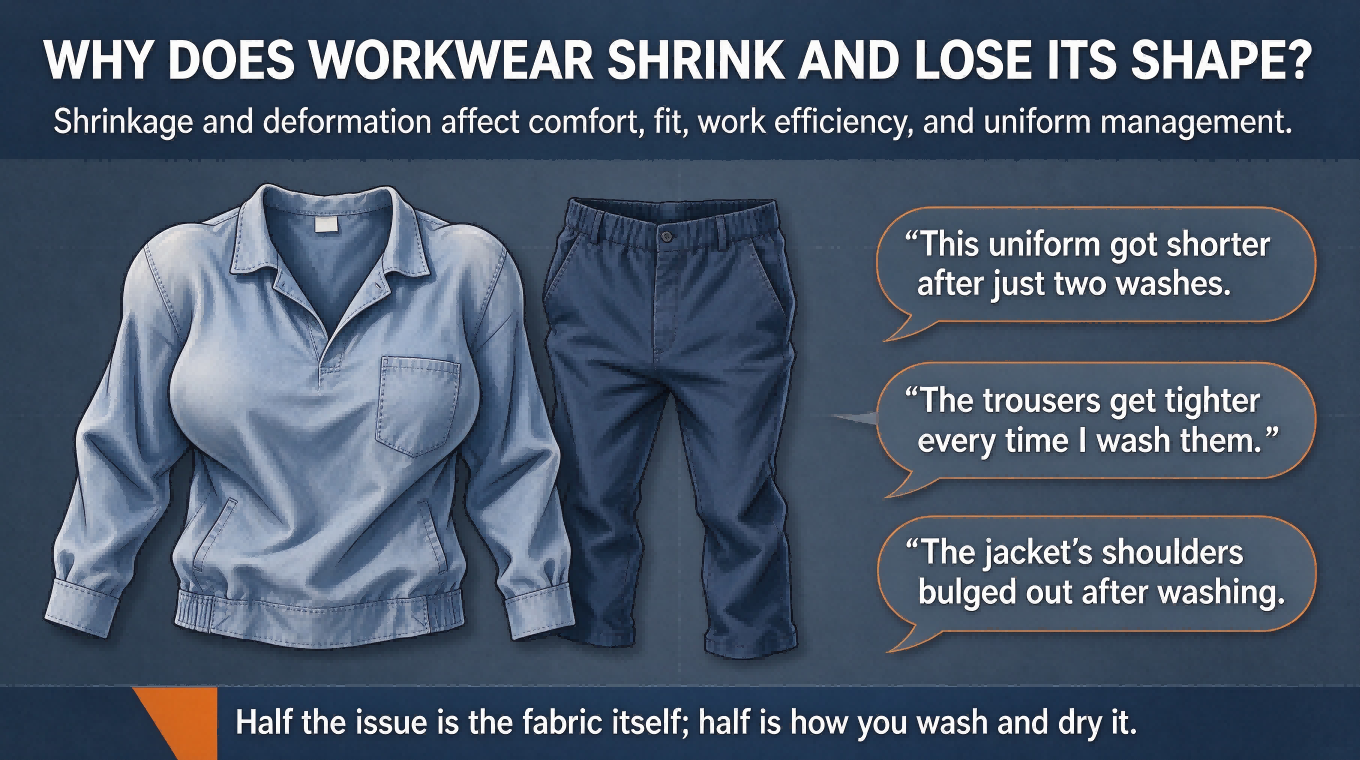
Anyone who buys workwear has probably heard employees complain like this: "This uniform got shorter after just two washes." "The trousers get tighter every time I wash them—I can barely squat down." "The jacket's shoulders bulged out after washing—it looks like I borrowed it from someone else."
Shrinkage and deformation might seem like small issues, but they directly affect employee comfort and work efficiency. What's worse, when bulk-ordered uniforms shrink, the sizes all go haywire, and even reordering becomes a nightmare.
Today, we're going to explain the causes of workwear shrinkage and deformation, then provide specific washing and care methods for different fabrics. Follow these, and your workwear will last at least one or two more seasons.
1. First, let's understand: why does workwear shrink?
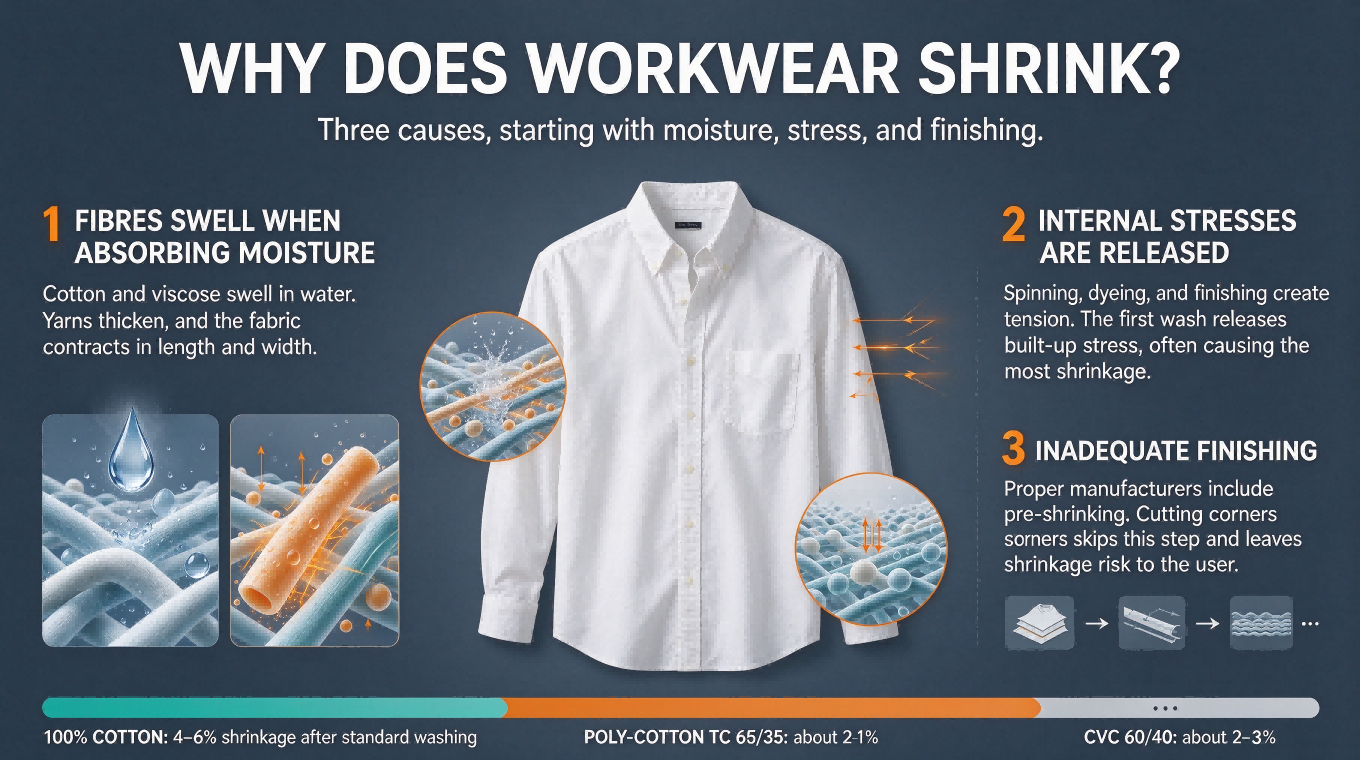
Shrinkage isn't just "the clothes got smaller"—there are three main reasons behind it.
Reason 1: Fibres swell when they absorb moisture
Natural and regenerated cellulose fibres like cotton and viscose swell when they absorb water. When fibres swell, the yarns thicken, and the fabric contracts in both length and width. This is the root cause of shrinkage in cotton workwear.
Reason 2: Internal stresses from weaving and finishing are released
During spinning, dyeing, and finishing, fibres and yarns are constantly under tension. The internal stresses built up from this tension are released on the first wash, causing the fabric to contract. That's why the first wash usually produces the most shrinkage.
Reason 3: Inadequate finishing
Legitimate manufacturers do pre-shrinking during finishing to keep shrinkage within standard limits. But manufacturers cutting corners skip this step—they save on cost and leave the shrinkage risk to the user.
Shrinkage rate data:
According to GB/T 41176-2021 "General Technical Requirements for Workwear", there are clear limits for dimensional change after washing. Generally:
- 100% cotton: shrinkage rate of 4% to 6% after standard washing.
- Poly-cotton (TC 65/35): shrinkage of about 2.1%.
- CVC (60/40): shrinkage of about 2% to 3%.
That means a 100% cotton uniform with a 70 cm garment length could shrink to 66–68 cm after a few washes. If it fits perfectly when purchased, it'll be too tight after a few washes.
2. Why does workwear lose its shape?
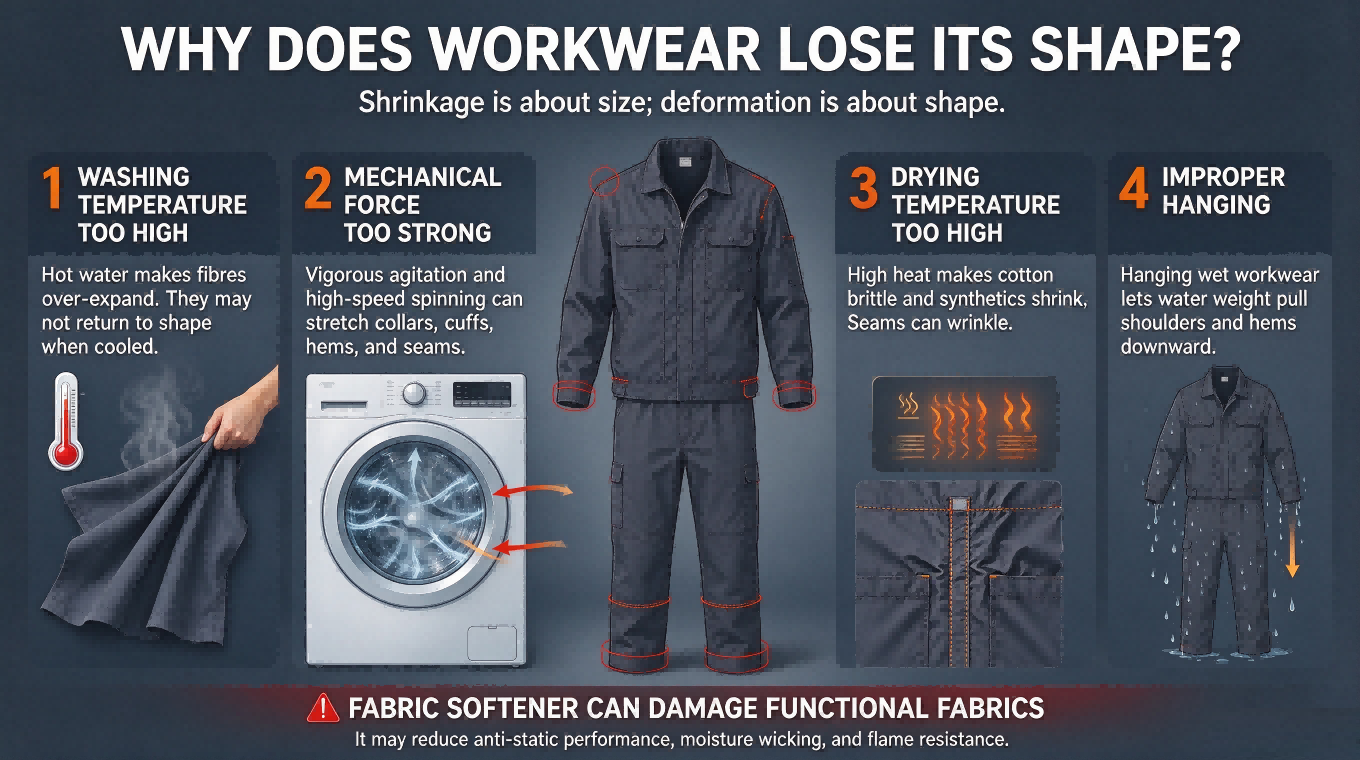
Shrinkage is about size getting smaller; deformation is about shape going out of whack. There are four main causes of deformation:
First, washing temperature is too high. Hot water makes fibres over-expand, and they can't return to their original shape when cooled, causing the fabric to wrinkle, stretch, or twist.
Second, mechanical force is too strong. Vigorous agitation and high-speed spinning in the washing machine can stretch and distort the fabric. Collars, cuffs, and hems are the most vulnerable.
Third, drying temperature too high. The high heat of a tumble dryer makes cotton fibres brittle, synthetic fibres shrink, and seams wrinkle.
Fourth, improper hanging. Hanging wet clothes directly to dry lets the weight of the water pull the garment downward, stretching the shoulders and deforming the hem. This is especially noticeable in knitted workwear.
One more thing that's easily overlooked – fabric softener. Softener coats the fibre surface. While it makes the fabric feel softer, it destroys anti-static performance, reduces moisture-wicking properties, and makes the fabric go limp.
3. Different fabrics need completely different washing methods
Workwear fabrics vary, and so do their washing and care methods. Let's go through the most common types.
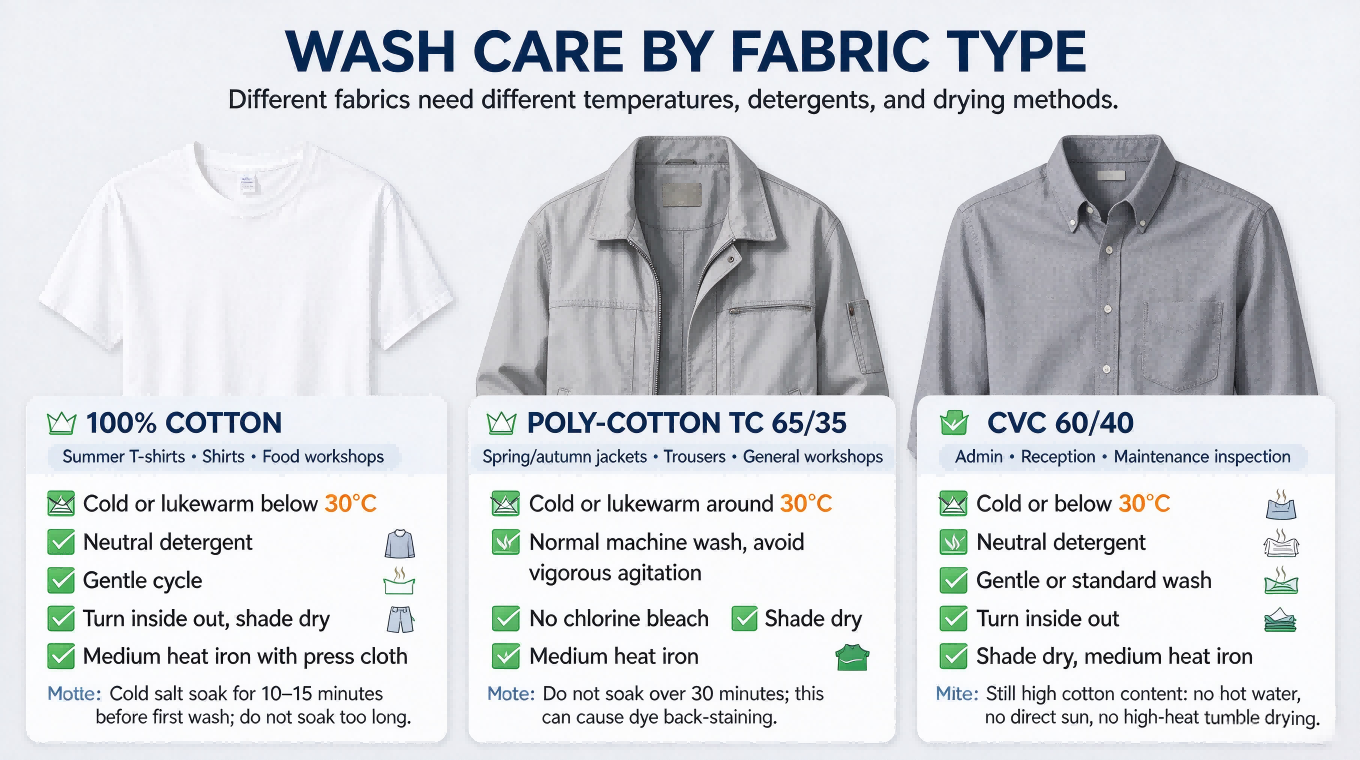
①100% cotton workwear (summer T-shirts, shirts, food workshop uniforms)
Cotton is comfortable and absorbs sweat, but it shrinks, wrinkles, and dries slowly.
Washing tips:
- Water temperature: cold or lukewarm below 30°C – no hot water.
- Detergent: neutral detergent – no strong alkaline washing powder.
- Cycle: choose gentle or cotton/linen on the machine.
- Don't wring hard: gently press out water – wringing stretches and deforms.
- Drying: turn inside out and dry in a shaded, ventilated area – no direct sun.
- Ironing: if needed, medium heat (around 150°C), use a pressing cloth.
Special note: Before the first wash, you can soak 100% cotton workwear in cold water with a little salt for 10–15 minutes to help stabilise the colour. But don't soak it too long – it can worsen shrinkage.
②Poly-cotton workwear (TC 65/35, spring/autumn jackets, trousers, general workshop uniforms)
Poly-cotton is durable, wrinkle-resistant, and has low shrinkage—it's the most commonly used workwear fabric. But it's less breathable and prone to pilling and deformation at high temperatures.
Washing tips:
- Water temperature: around 30°C cold or lukewarm – not above 40°C.
- Detergent: neutral or mildly alkaline liquid detergent.
- Cycle: normal machine wash is fine – avoid vigorous agitation.
- Bleach: no chlorine bleach – it damages fibres and causes fading.
- Drying: shaded, ventilated area – avoid direct sun.
- Ironing: medium heat, avoid direct high heat.
Special note: Don't soak poly-cotton workwear for long periods. Soaking over 30 minutes can cause dye back-staining and uneven colour.
③CVC workwear (60/40, admin, reception, maintenance inspection)
CVC has a higher cotton content than polyester, so comfort is close to cotton, but it's more wash-resistant and wrinkle-resistant than cotton.
Washing tips:
- Water temperature: cold or below 30°C.
- Detergent: neutral detergent.
- Cycle: gentle or standard machine wash.
- Turn inside out: reduces surface friction, protects colour and hand-feel.
- Drying: shade dry, turn inside out.
- Ironing: medium heat, use a pressing cloth.
Special note: Although CVC is more wash-resistant than cotton, it still contains a high cotton content – no hot water, no direct sun, no high-heat tumble drying.
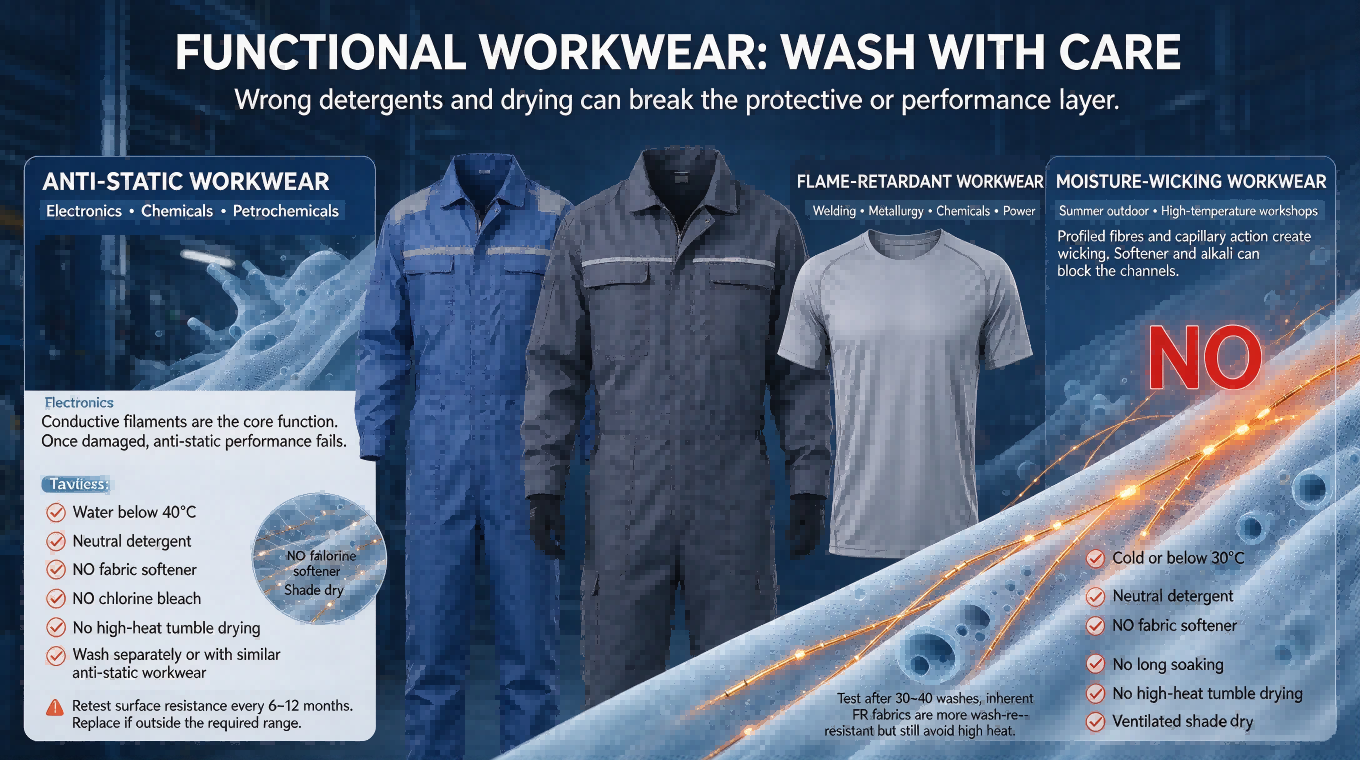
④Anti-static workwear (electronics, chemicals, petrochemicals)
The core of anti-static workwear is the conductive filaments in the fabric. Once the filaments break, the anti-static function fails.
Washing tips:
- Water temperature: below 40°C – cold or lukewarm recommended.
- Detergent: neutral detergent.
- Absolutely no fabric softener – softener forms an insulating layer on the conductive fibres, directly destroying anti-static performance.
- No chlorine bleach.
- No high-heat tumble drying.
- Wash separately, or with similar anti-static workwear.
- Drying: shaded, ventilated area.
Special note: Anti-static workwear should be retested for surface resistance every 6 to 12 months. If surface resistance falls outside the range specified in GB 12014-2019, replace it.
⑤ Flame-retardant workwear (welding, metallurgy, chemicals, power)
Flame-retardant workwear comes in inherent and treated types. For treated flame-retardant workwear, washing methods directly affect the flame-retardant lifespan.
Washing tips:
- Water temperature: below 40°C.
- Detergent: neutral detergent.
- No chlorine bleach – it destroys the flame-retardant finish.
- No fabric softener – it affects flame-retardant performance.
- Treated flame-retardant workwear should be sent for testing after 30 to 40 washes to confirm flame-retardant performance.
- Inherent flame-retardant workwear is more wash-resistant, but still avoid high-heat drying and strong mechanical action.
- Drying: shaded, ventilated area.
Special note: If flame-retardant workwear gets stained with oil or flammable liquids, clean it thoroughly before wearing. Otherwise, the fabric absorbs flammable liquids and actually loses its flame-retardant protection.
⑥ Moisture-wicking quick-dry workwear (summer outdoor, high-temperature workshops)
Moisture-wicking relies on the profiled fibre cross-sections and capillary action. Fabric softener and alkaline detergents block the capillary channels, causing the quick-dry function to fail.
Washing tips:
- Water temperature: cold or below 30°C.
- Detergent: neutral detergent – no alkaline washing powder.
- No fabric softener.
- No long soaking.
- No high-heat tumble drying.
- Drying: ventilated area, avoid direct sun.
Special note: Moisture-wicking workwear is evaluated according to GB/T 21655.1-2023. It must meet water absorption rate, drop diffusion time, and drying rate indicators both before and after washing. If it fails after a few washes, it doesn't meet the standard.
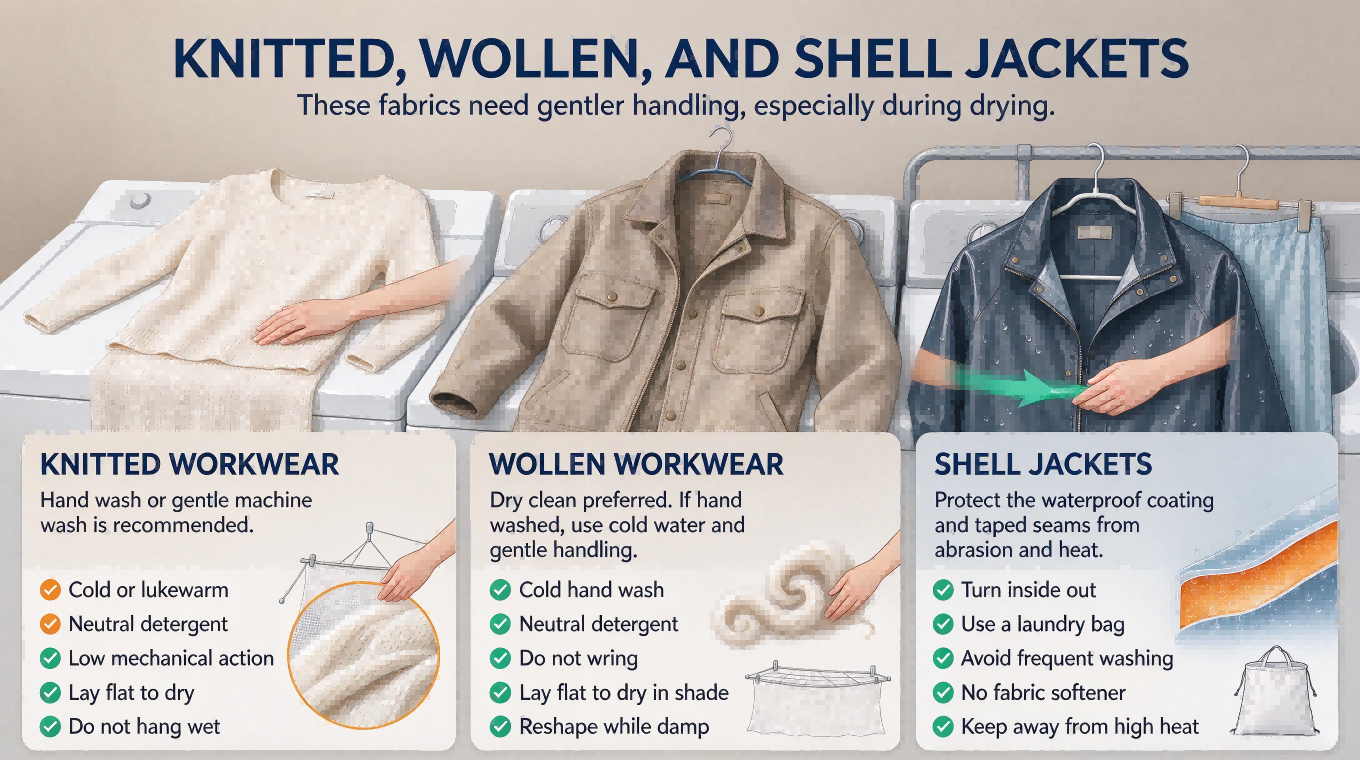
⑦Knitted, woollen, and shell jacket workwear
These are the most delicate.
- Knitted: hand wash or gentle machine wash recommended. Lay flat to dry – don't hang, or it will stretch.
- Woollen: dry clean recommended, or cold hand wash, lay flat to dry.
- Shell jackets: turn inside out, use a laundry bag, avoid scratching the waterproof coating, don't wash frequently, no fabric softener.
4. How to read the wash care label? Remember a few key symbols
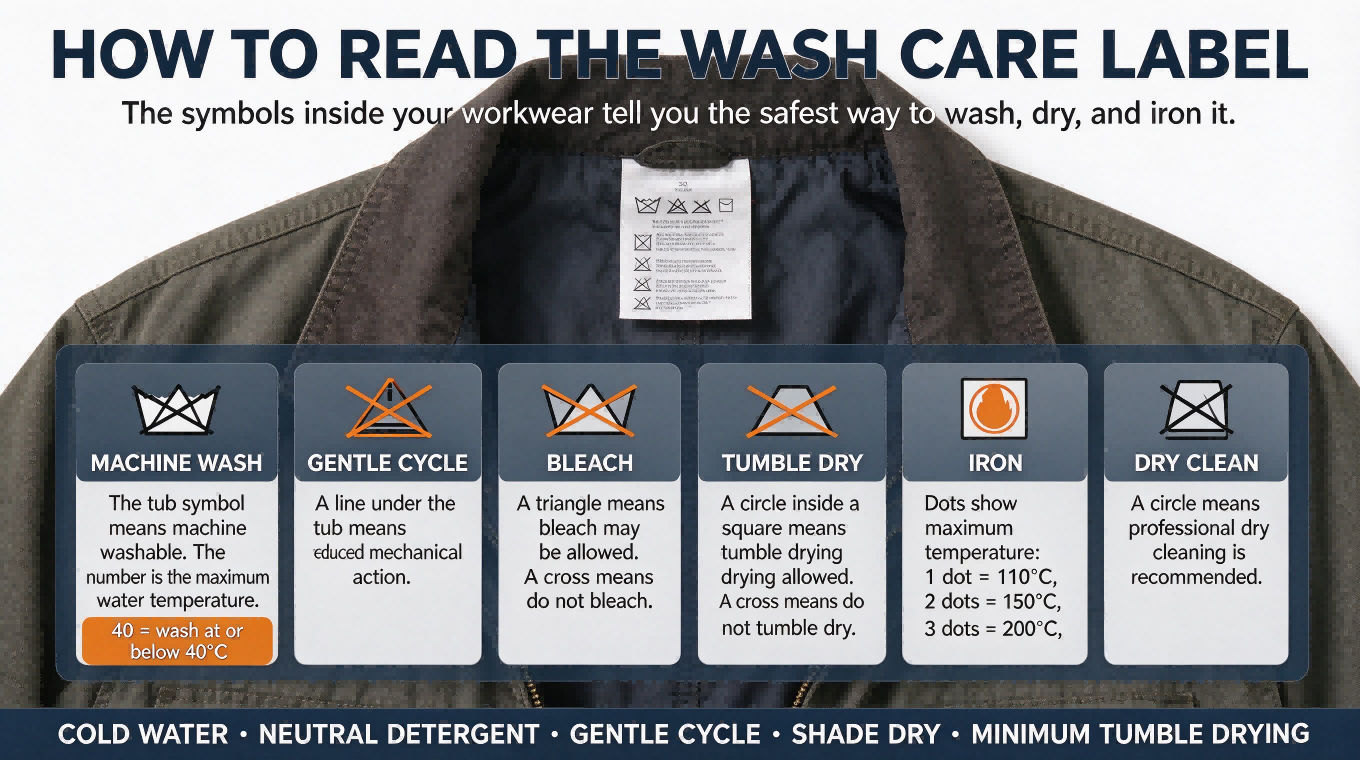
The permanent care label inside workwear has washing recommendations. Key symbols include:
- Tub: machine washable. The number inside is the maximum water temperature (e.g. 40 means 40°C).
- Tub with a line underneath: gentle cycle.
- Triangle: bleach allowed. A cross through it means no bleach.
- Square with a circle inside: tumble drying allowed. Crossed out means no tumble drying.
- Iron: ironing allowed. Dots indicate temperature (1 dot = 110°C, 2 dots = 150°C, 3 dots = 200°C).
- Circle: professional dry clean.
If you can't read the symbols, just remember the principles: cold water, neutral detergent, gentle cycle, shade dry, minimal tumble drying.
5. Five universal rules – they apply to any fabric
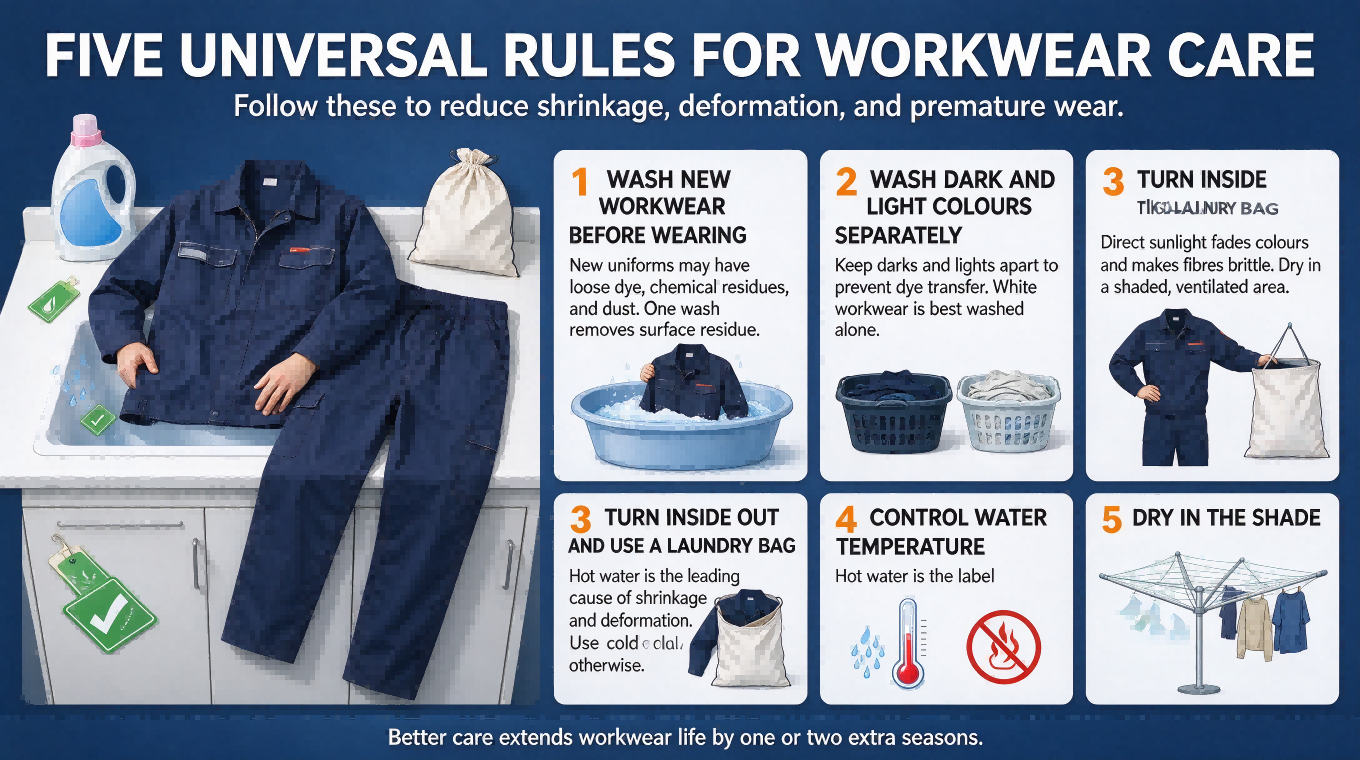
Rule 1: Wash new workwear before wearing. New uniforms have loose dye, chemical residues, and dust. One wash removes surface residue and is more hygienic.
Rule 2: Wash dark and light colours separately. Keep darks and lights apart to prevent dye transfer. White workwear is best washed on its own.
Rule 3: Turn inside out and use a laundry bag. Reduces surface friction and protects colour, prints, and functional layers.
Rule 4: Control water temperature – no hot water. Hot water is the number one killer causing shrinkage and deformation. Unless the care label explicitly allows it, use cold or lukewarm water below 30°C.
Rule 5: Dry in the shade, not in direct sun. Direct sunlight fades colours and makes fibres brittle. A shaded, ventilated spot is best.
6. A summary table: how to wash different workwear
| Fabric type | Water temp | Detergent | Fabric softener | Bleach | Tumble dry | Drying |
| 100% cotton | Cold/30°C | Neutral | OK (use sparingly) | Not recommended | Not recommended | Inside out, shade |
| Poly-cotton TC | Below 30°C | Neutral | OK (use sparingly) | No chlorine | Not recommended | Shade |
| CVC | Cold/30°C | Neutral | OK (use sparingly) | No chlorine | Not recommended | Inside out, shade |
| Anti-static | Below 40°C | Neutral | Do not use | No chlorine | Not recommended | Shade |
| Flame-retardant | Below 40°C | Neutral | Do not use | No chlorine | Not recommended | Shade |
| Moisture-wicking | Cold/30°C | Neutral | Do not use | No chlorine | Not recommended | Ventilated shade |
| Knitted/woollen | Cold hand wash | Neutral | Use sparingly | No | No | Lay flat, shade |
A final honest word
Workwear shrinkage and deformation are half about the fabric itself and half about washing and care. 100% cotton has a high shrinkage rate, and if finishing is inadequate, it gets shorter after a few washes. But even with good fabric, hot water, direct sun, and high-heat drying will still cause shrinkage and deformation.
During procurement, write shrinkage rate, colour fastness, and washing methods into the contract and technical specification sheet. When distributing, give employees a simple care guide. During use, remind employees: cold water, neutral detergent, turn inside out and dry in the shade, and no fabric softener for functional workwear.
Follow these, and your workwear won't "fall apart after a few washes." Employees stay comfortable, and the company saves on repeated purchases.