O que você está procurando?


The easiest mistake to make in workwear procurement is this: treating a quotation sheet as the basis for your decision.
Three suppliers quote: Supplier A at 98 yuan per set, Supplier B at 72 yuan, Supplier C at 58 yuan. A lot of people close their eyes and pick Supplier C. The result? Within three months, employees are complaining about stuffiness, pilling, shrinking, and split seams. The promised anti-static performance fails after a dozen washes. And when you try to reach the supplier, the phone doesn't connect and WeChat goes unanswered.
Cheap things only make you happy at the moment you buy them. Expensive things only hurt at the moment you pay. Workwear is labour equipment that employees wear every day and wash every week. Choose the wrong manufacturer, and you're in for endless trouble.
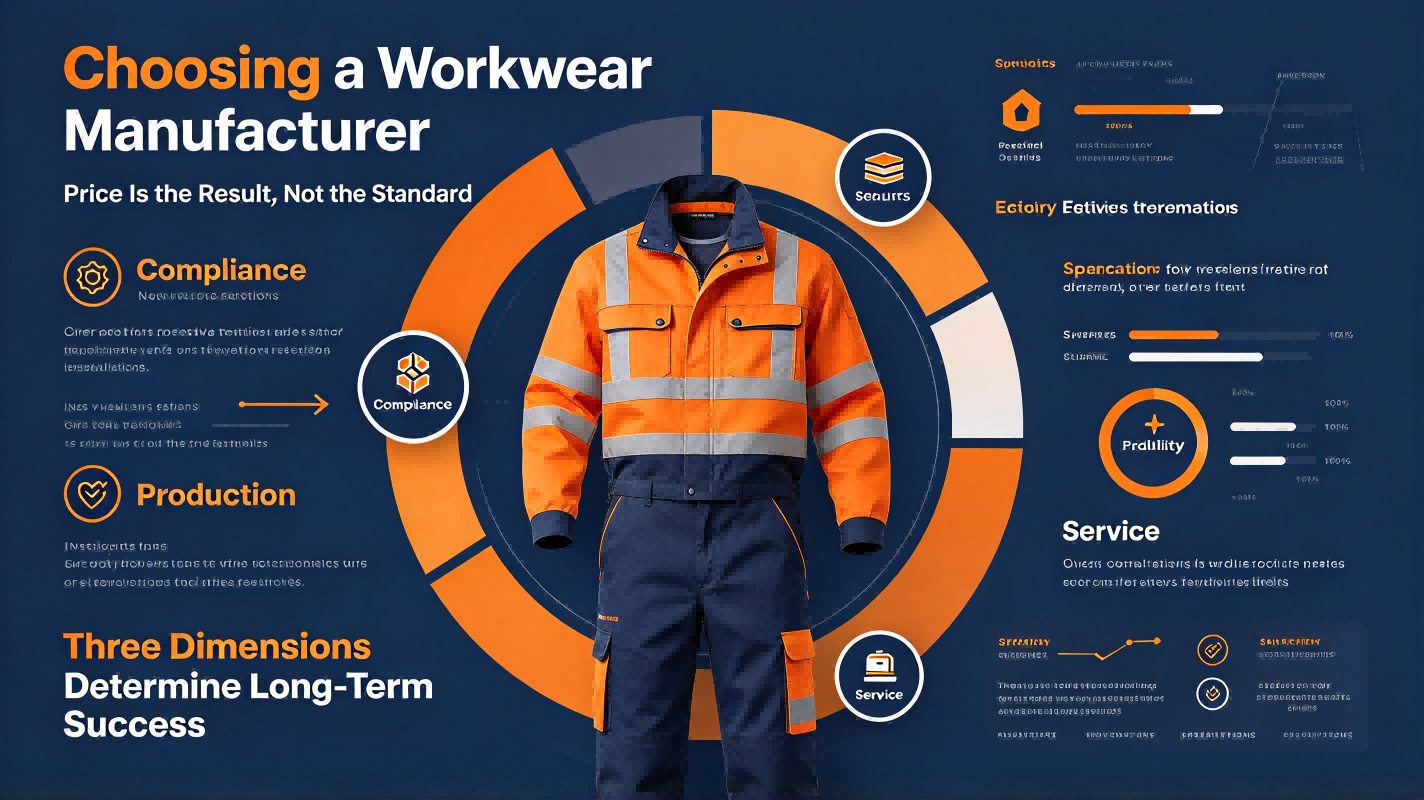
Today we're going to make this clear: don't just look at price. Three dimensions really determine success or failure: compliance and standards capability, production and quality control capability, and service and after-sales capability. After reading this, you'll have confidence when you talk to suppliers again.
Dimension 1: Compliance and standards capability – whether they can do it legally matters a hundred times more than whether it's cheap
Workwear isn't ordinary clothing. If ordinary clothing is non-compliant, the worst case is discomfort. If workwear is non-compliant, it can involve safety, health, and even legal liability.
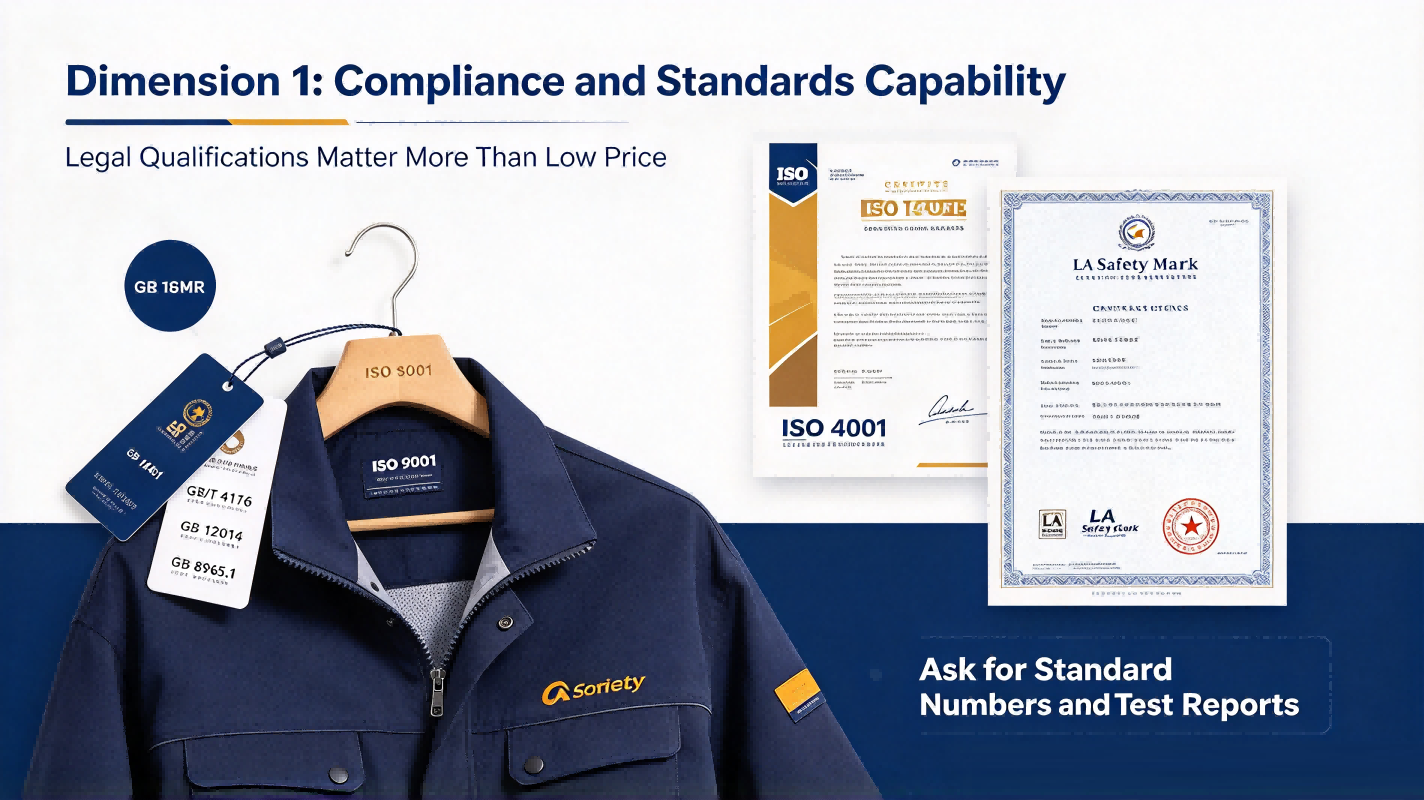
So the first thing to ask a manufacturer isn't the price. It's: Do you have the qualifications? What standards do you follow? Can you produce the test reports?
1. First, check basic qualifications
A legitimate workwear manufacturer should at least have:
- A business licence, with a business scope covering garment production or sales;
- ISO 9001 quality management system certification;
- ISO 14001 environmental management system certification;
- ISO 45001 occupational health and safety management system certification.
If they make special labour protection products—anti-static clothing, flame-retardant clothing, acid-alkali resistant clothing—they must also obtain the Special Labour Protection Product Safety Mark (LA safety mark). Without an LA certificate, they cannot legally produce or sell special labour protection products.
During procurement, you can directly ask the supplier for the LA certificate number and verify its validity period and product scope on the relevant national platform.
2. Then check standards execution capability
Workwear safety and functionality all have corresponding national standards. A legitimate manufacturer can accurately state the standard numbers they follow and provide third-party test reports.
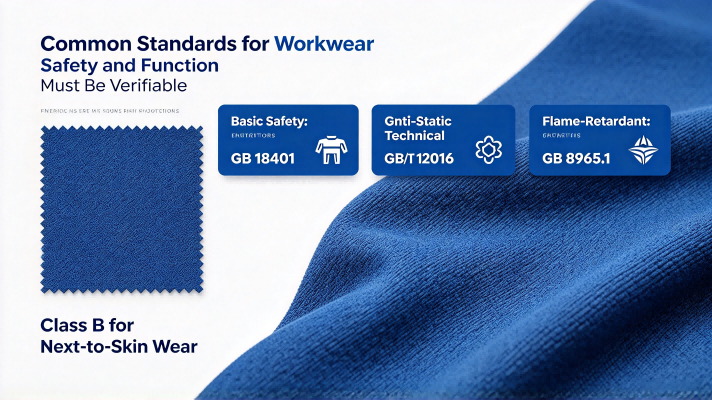
Common standards include:
- GB 18401-2010 "National General Safety Technical Code for Textile Products" – basic safety indicators such as formaldehyde, pH value, prohibited carcinogenic aromatic amine dyes, and colour fastness. Next-to-skin workwear must meet at least Class B; non-next-to-skin workwear must meet at least Class C.
- GB/T 41176-2021 "General Technical Requirements for Workwear" – the general technical basis for workwear, covering appearance, specifications, physical and chemical performance, etc.
- GB 12014-2019 "Protective clothing – Anti-static clothing" – mandatory for anti-static clothing. Core indicators include surface resistance, charge quantity, and performance retention after 50 washes.
- GB 8965.1-2020 "Protective clothing – Flame-retardant clothing" – mandatory for flame-retardant clothing. Divided into Level A and Level B. Core indicators include afterflame time, afterglow time, char length, and melt dripping.
3. Beware of "concept-only suppliers"
Some suppliers claim they can do everything: "We can do anti-static, flame-retardant, moisture-wicking, acid-alkali resistant—all of it." But when you ask for a standard number, they get vague. When you ask for a test report, they say it's "being processed." When you ask about post-wash performance, they change the subject.
This kind of supplier can basically be judged as "concept-only"—they take orders with concepts, deliver with ordinary fabric, and argue when problems arise.
Ask these questions directly during procurement:
- Does your anti-static clothing comply with GB 12014-2019? What's the surface resistance? Do you have a report after 50 washes?
- Is your flame-retardant clothing Level A or Level B? Inherent or treated flame retardancy? Can I see the flame-retardant report after 50 washes?
- Can you provide formaldehyde, pH, and colour fastness test reports? Is the safety category Class B or Class C?
If they can answer fluently, keep talking. If they hem and haw, skip them.
Dimension 2: Production and quality control capability – whether they can deliver good goods on time is more critical than whether they can make them
Having qualifications and standards doesn't mean stable delivery. Many buyers fall into this trap: the sample is great, the bulk order is a mess; delivery keeps getting delayed; and when problems arise, no one can be found.
So the second dimension is the manufacturer's production capacity and quality control system.
1. Own factory or trading company?
Trading companies aren't necessarily bad to work with, but the risk is: their control over production is weak, and delivery schedules and quality can easily slip. A manufacturer with its own factory controls the entire process—cutting, sewing, inspection, packaging—and the probability of problems is much lower.
If the order volume is large, it's recommended to audit the factory on-site, or at least do a video audit. What to look at?
- Cutting workshop: Is there computerised marker-making and automated cutting?
- Sewing workshop: Are the assembly lines standardised? Are all workstations in place?
- Buttonholing, button-sewing, ironing, packaging: Are these independent processes?
- Quality control: Are there dedicated QC positions and records?
2. Can capacity and lead time match?
Ask clearly: What's the monthly capacity? What's the current order backlog? If we place an order for 3,000 sets, what's the lead time? What happens if it's delayed?
Some manufacturers quote low prices because they take on too many orders at once, can't keep up with capacity, and end up either delaying or outsourcing to small workshops. After outsourcing, quality and delivery become even less controllable.
3. Is the quality control process complete?
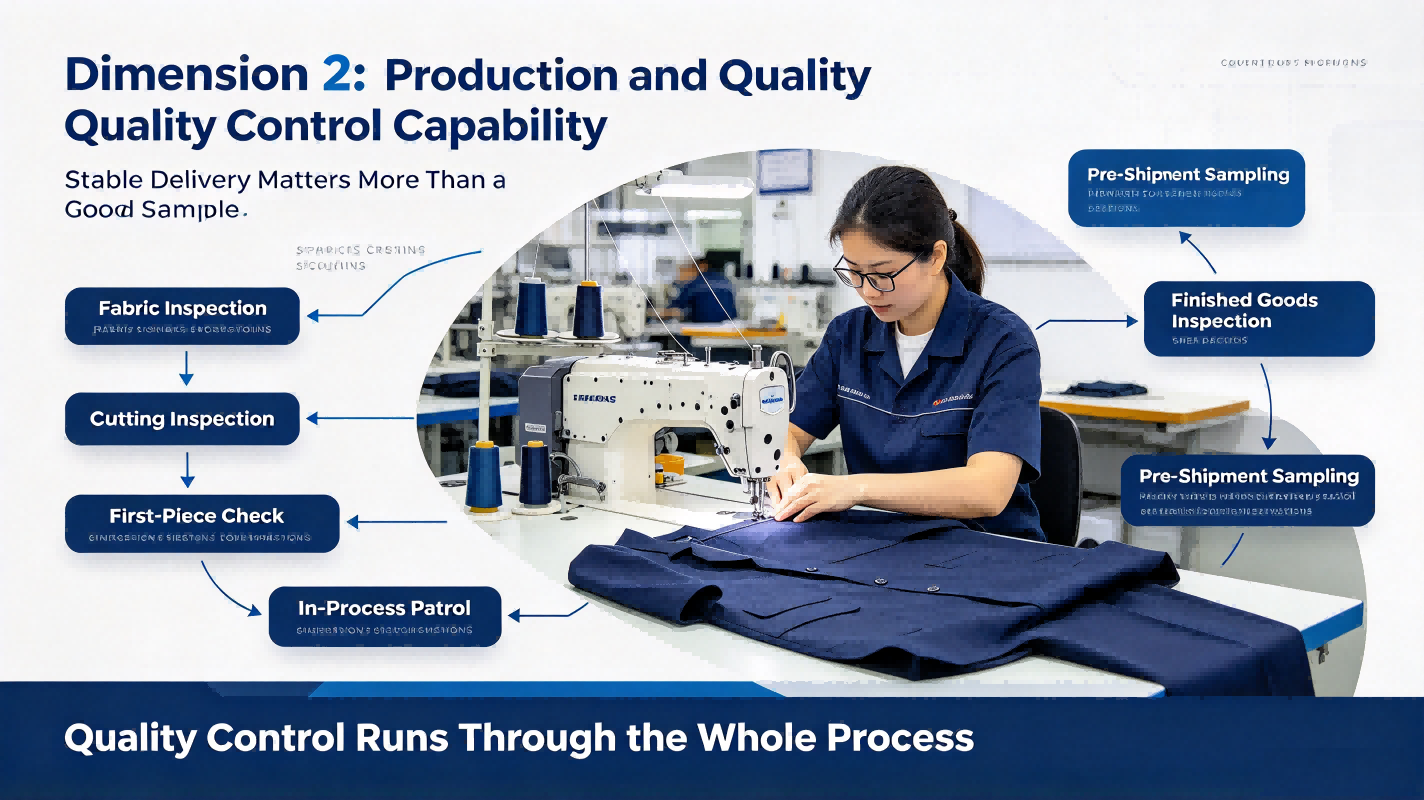
A legitimate manufacturer's quality control isn't "a final glance" – it runs through the entire process. At minimum, it should include:
- Incoming fabric and trim inspection: checking composition, weight, colour difference, safety indicators;
- Cutting inspection: checking cut piece dimensions, quantity, defects;
- First-piece inspection during sewing: confirming workmanship on the first finished piece;
- In-process patrol inspection: regular spot checks at each process;
- Full or sampling inspection of finished goods: checking appearance, dimensions, functionality;
- Pre-shipment sampling inspection: sampling according to AQL standards or contract terms.
During procurement, you can ask the supplier for quality control process documents and recent sampling inspection records. If they can't provide them, quality control may be just talk.
4. Is sealed sample management in place?
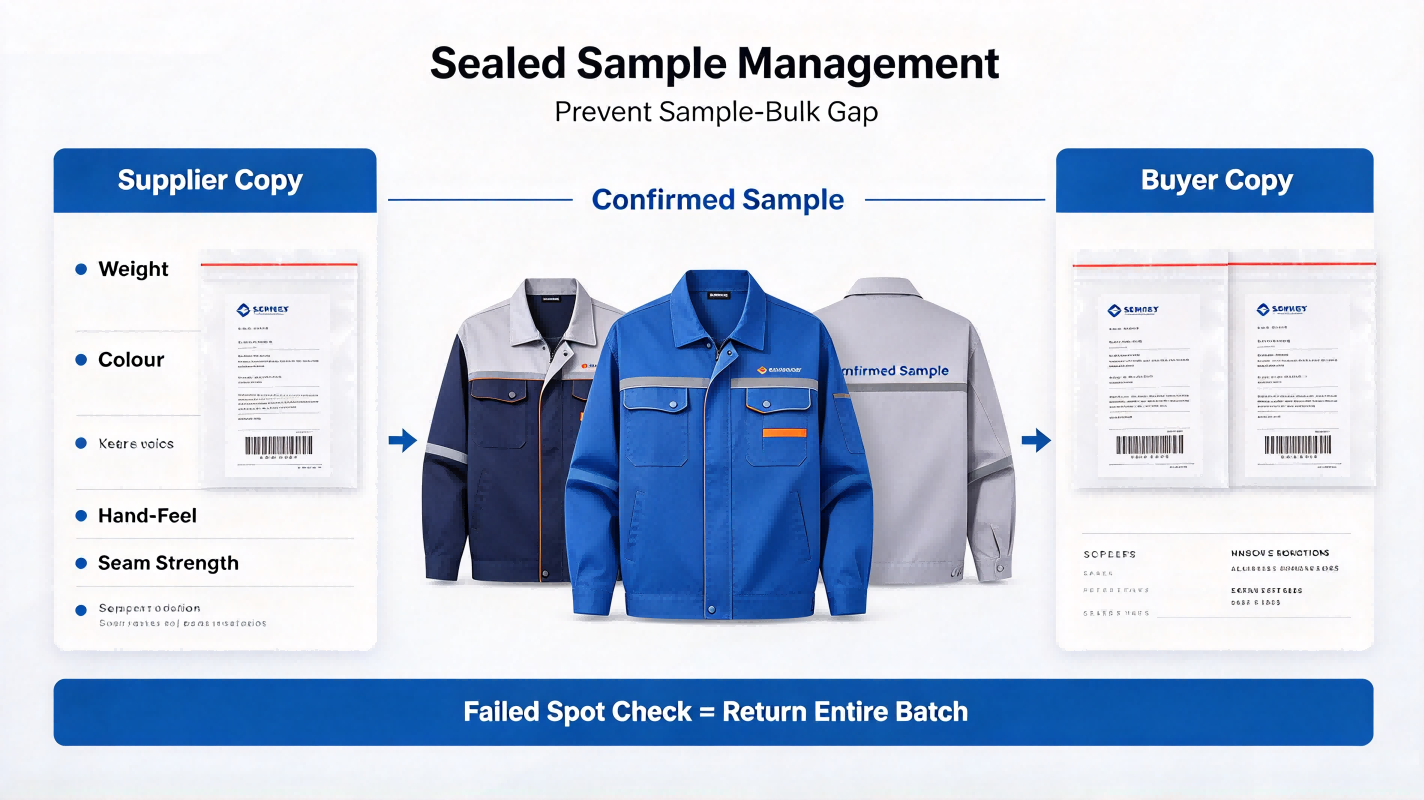
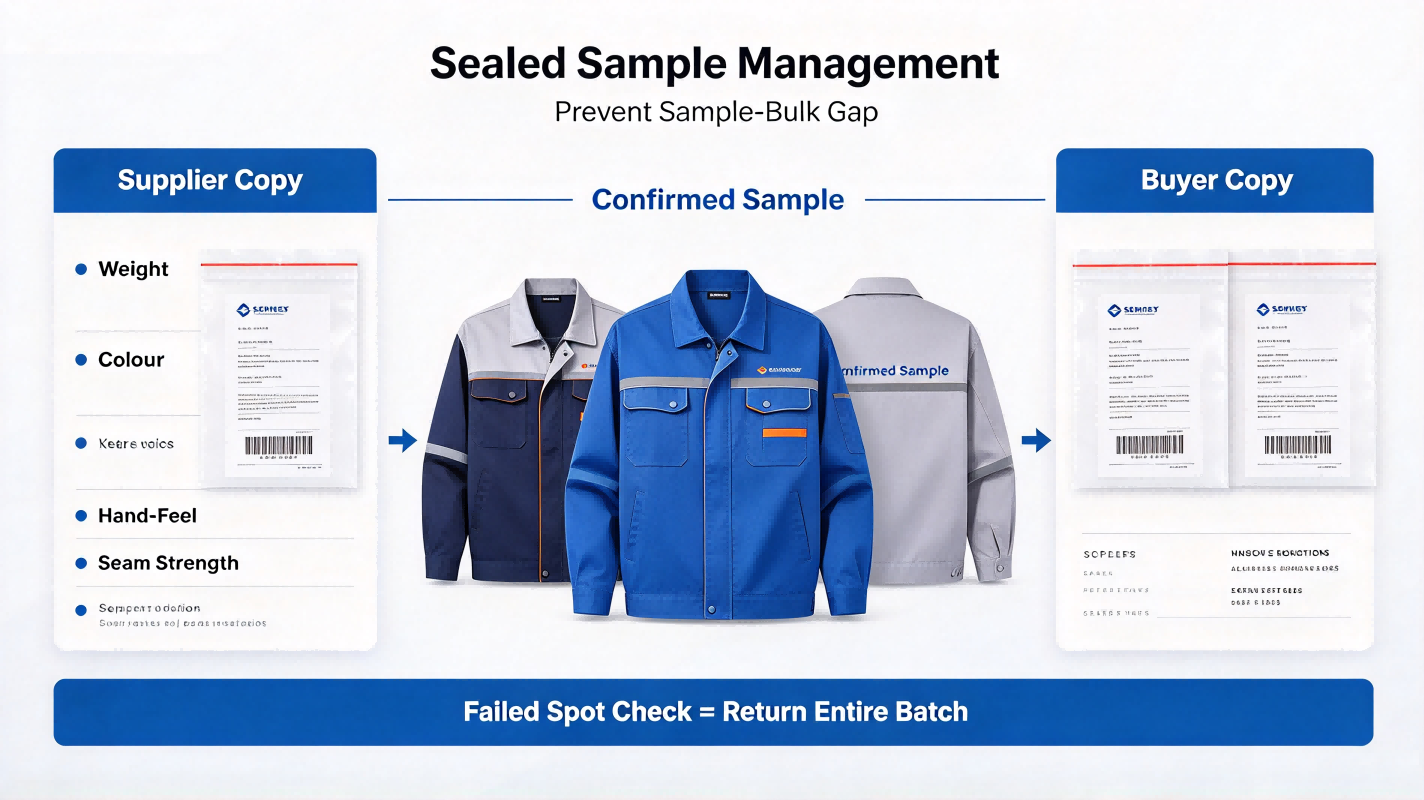
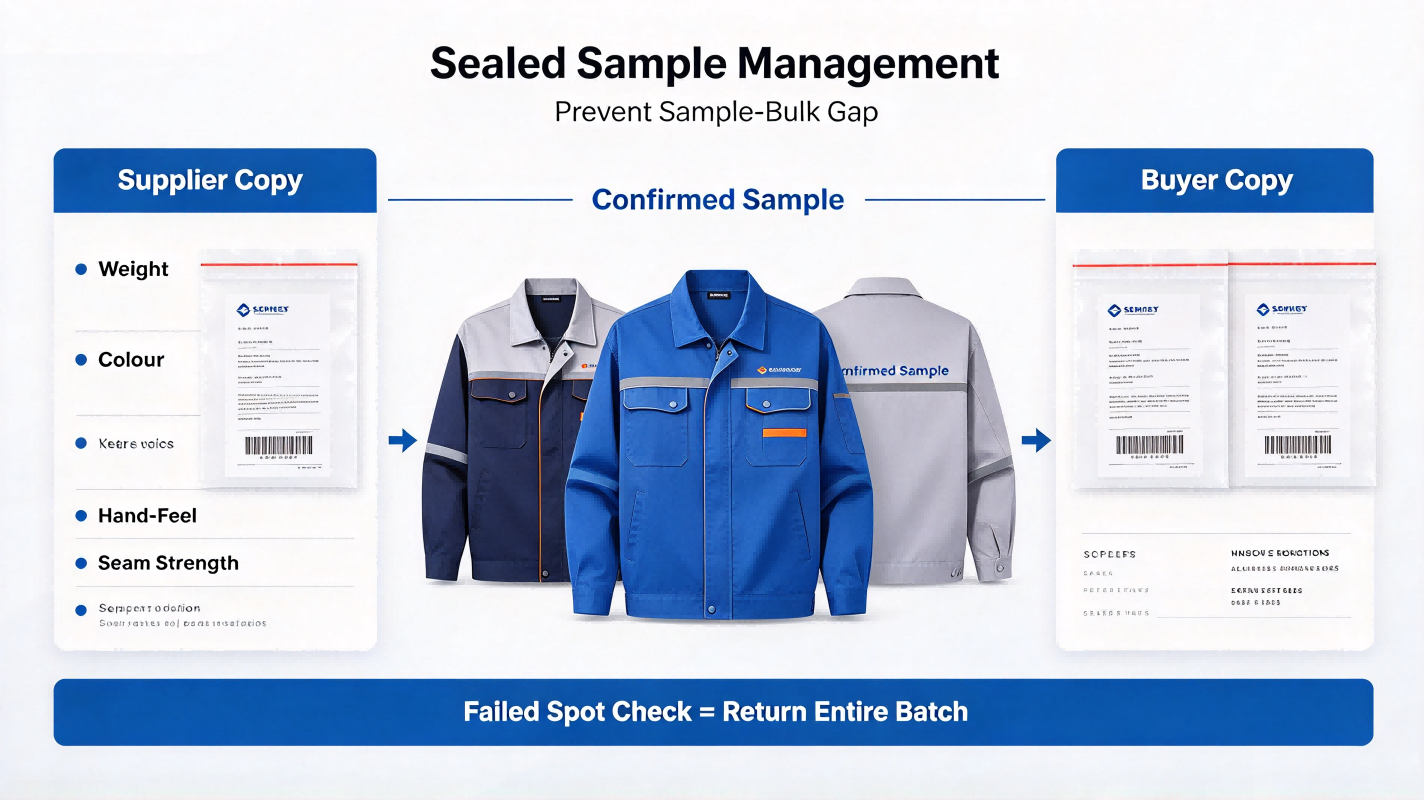
Sealed samples are the most effective way to prevent "samples not matching bulk production." After confirming the sample, both parties sign and seal it, each keeping one copy. When the bulk order arrives, randomly sample and compare weight, colour, hand-feel, and seam strength. The contract must clearly state: if spot checks fail, the entire batch is returned, and the supplier bears round-trip shipping.
5. How are delivery delays handled?
The contract must state: late delivery incurs a penalty per day as a per-mille of the total contract value; if the delay exceeds a certain number of days, the buyer has the right to cancel the order. A contract without penalty clauses has no binding force.
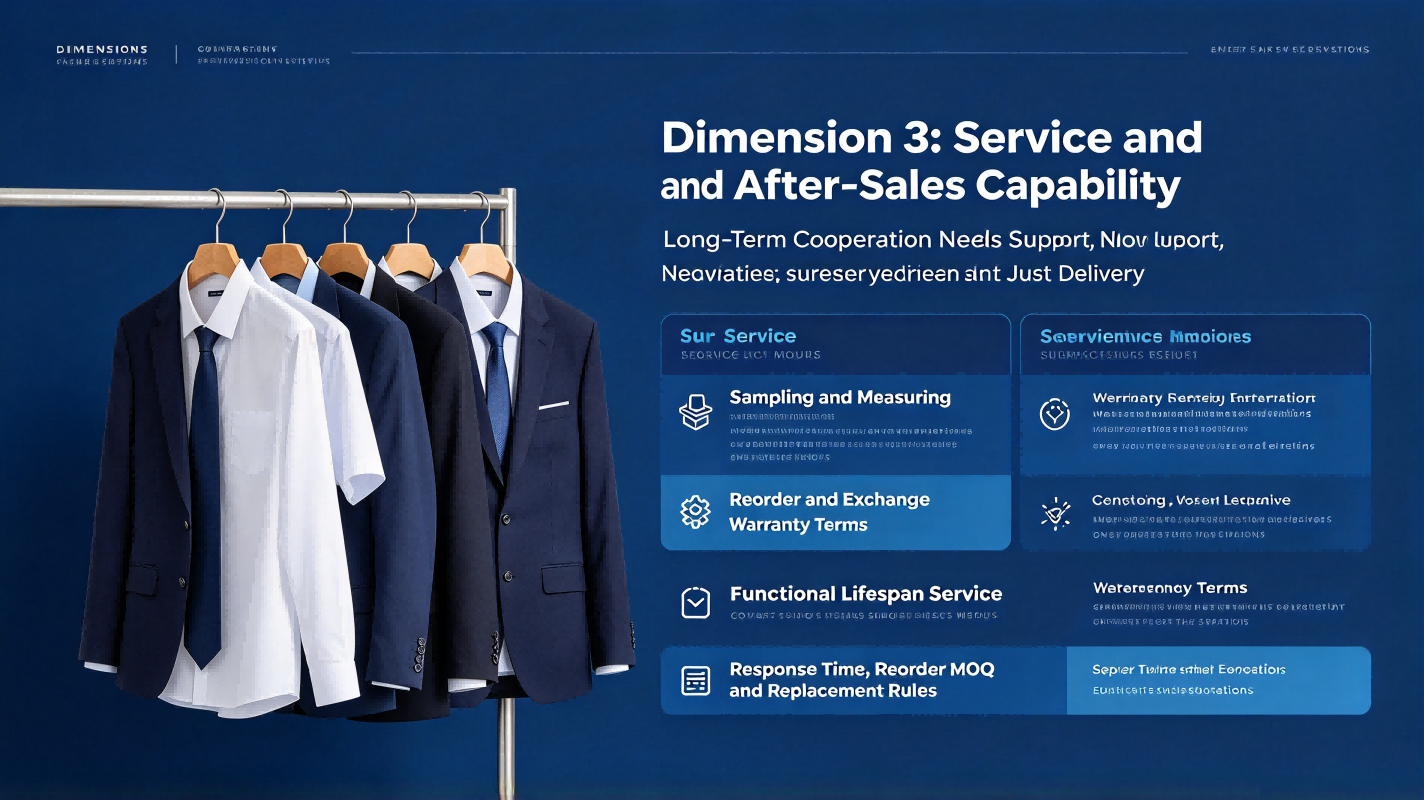
Dimension 3: Service and after-sales capability – whether they can support long-term cooperation matters more than a single cheap order
Workwear isn't a one-off deal. Employees come and go, sizes need reordering, workwear gets damaged, and functions degrade. So a manufacturer's service and after-sales capability directly determines how much hassle you'll face later.
1. Sampling and measuring services
A legitimate manufacturer can provide:
- Free or paid sampling to confirm style, fabric, and workmanship;
- On-site measuring, especially for companies with many employees and varied body types;
- Size recommendation plans to reduce returns and exchanges due to sizing issues.
If a manufacturer isn't even willing to make a sample, or charges an absurdly high sampling fee, cooperation later will likely be rough.
2. Reorder and exchange mechanisms
Employee turnover, new hires, and damaged workwear all require reorders. Ask clearly:
- What's the minimum order quantity for reorders? Will they accept 10 or 20 pieces?
- Is the reorder price the same as the initial order? Will they mark it up?
- What's the lead time for reorders?
- How many days do employees have to exchange for wrong sizes or quality issues?
Some manufacturers offer a very low first-order price, but double the reorder price, or require a minimum of 100 pieces for reorders. These hidden costs must be clarified in advance.
3. Warranty and after-sales terms
The contract should state:
- How long is the warranty? One year or two?
- During the warranty period, if non-human damage occurs (seam splitting, severe fading, functional failure), will the supplier replace it free of charge?
- For functional workwear (anti-static, flame-retardant), is there periodic testing service? Who bears the testing cost?
- What's the after-sales response time? 24 hours or 48 hours?
4. "Functional lifespan" service for functional workwear
Anti-static clothing loses conductivity as filaments break; flame-retardant clothing loses performance with repeated washing. A professional manufacturer will provide:
- Washing and care guidelines, telling employees how to wash and what not to use;
- Periodic testing recommendations, such as retesting surface resistance every 6 to 12 months for anti-static clothing;
- Replacement plans after functional failure.
A manufacturer that only sells clothes but doesn't care about functional lifespan is not a professional manufacturer.
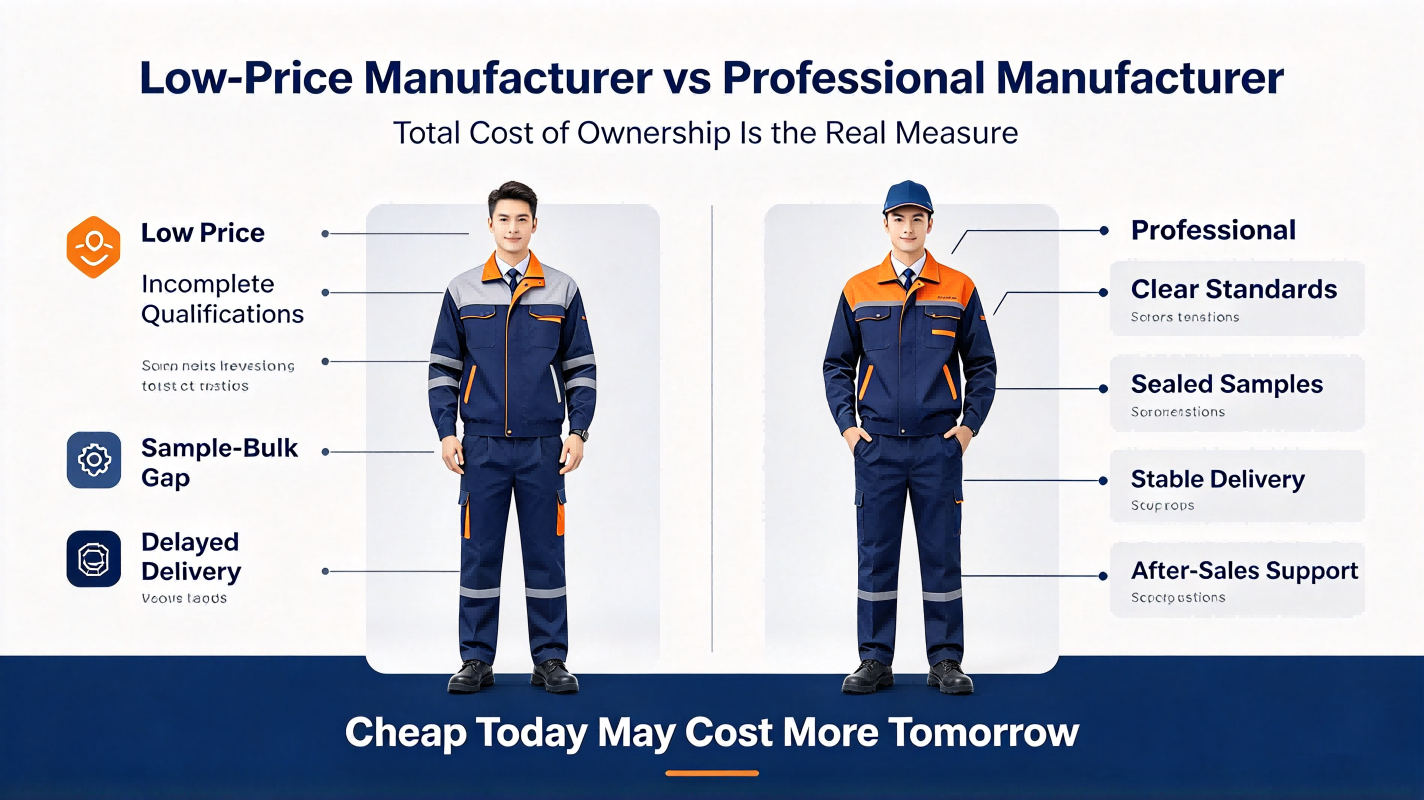
A table to see clearly: low-price manufacturer vs. professional manufacturer
|
Comparison |
Low-price manufacturer |
Professional manufacturer |
|
Quotation |
Clearly below market average |
Reasonable, transparent |
|
Qualifications |
Incomplete, no LA mark |
Complete, with LA certificate |
|
Standards |
Can't explain execution standard |
Clear standard numbers, provides test reports |
|
Samples |
Good sample, poor bulk |
Sealed samples kept, bulk matches |
|
Quality control |
A final glance |
Full-process inspection, with records |
|
Delivery |
Frequently delayed |
Clear lead time, penalty clauses |
|
After-sales |
Can't be found |
Timely response, smooth reorders |
|
Functional lifespan |
Fails after a few washes |
Provides post-wash test reports |
|
Long-term cost |
Looks cheap, actually more expensive |
Slightly higher unit price, lower annual cost |
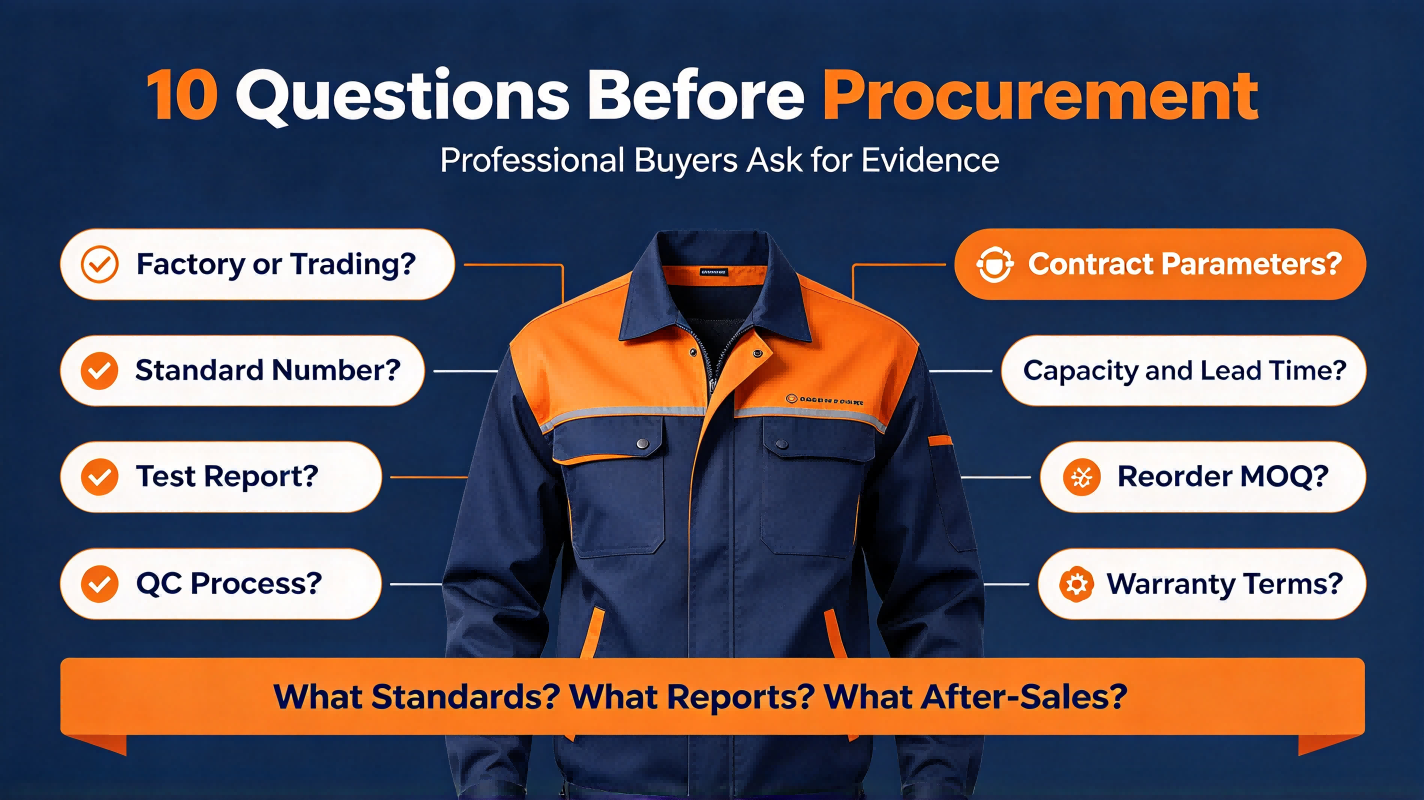
10 questions you must ask before procurement
1. Are you an own factory or a trading company?
2. Does your anti-static clothing comply with GB 12014-2019? What's the surface resistance?
3. Is your flame-retardant clothing Level A or Level B? Inherent or treated flame retardancy?
4. Can you provide formaldehyde, pH, and colour fastness test reports? Is the safety category Class B or Class C?
5. Can fabric weight, yarn count, and density be written into the contract?
6. What's your monthly capacity? What's the lead time for 3,000 sets?
7. What steps are in your quality control process? Are there records?
8. What's the minimum reorder quantity? Is the reorder price the same as the first order?
9. How long is the warranty? How do you handle non-human damage?
10. Can the contract include a technical specification sheet and acceptance criteria?
A manufacturer that can answer these 10 questions clearly is worth working with even if the price is a bit higher. If they can't answer clearly, be very cautious no matter how low the quote is.
A final honest word
When choosing a workwear manufacturer, price is the result, not the standard.
The definition of cheap isn't "low quote" – it's "low total cost of ownership." A work set that lasts one year versus two years means the annual cost differs by double. One delivery delay and one quality incident can cost far more than what you saved on procurement.
The definition of professional isn't "can do everything" – it's "everything has standards, records, and after-sales support." A manufacturer that can produce standard numbers, test reports, sealed sample records, and after-sales terms is a truly reliable long-term partner.
Next time you talk to a workwear manufacturer, don't ask "How much?" first. Ask: "What standards do you follow? Can I see the test reports? Can I audit the factory? How do you guarantee after-sales?" – being able to ask those questions already makes you more professional than 90% of buyers.