O que você está procurando?


When new uniforms are handed out to employees, do you let them wear them straight away, or do you run them through the wash first?
A lot of procurement teams think, "The new clothes look clean enough, no need to wash them." Employees also find it a hassle, so they tear open the packaging and put them on. But workwear isn't ordinary clothing – it goes through spinning, weaving, dyeing, finishing, cutting, sewing, packaging, warehousing, and shipping. Dozens of processes later, you have no idea what's ended up on that fabric.
Today we're going to tackle the whole "to wash or not to wash" question and walk through everything you need to know about washing and caring for work uniforms. Five practical tips – useful for procurement, admin, and employees alike.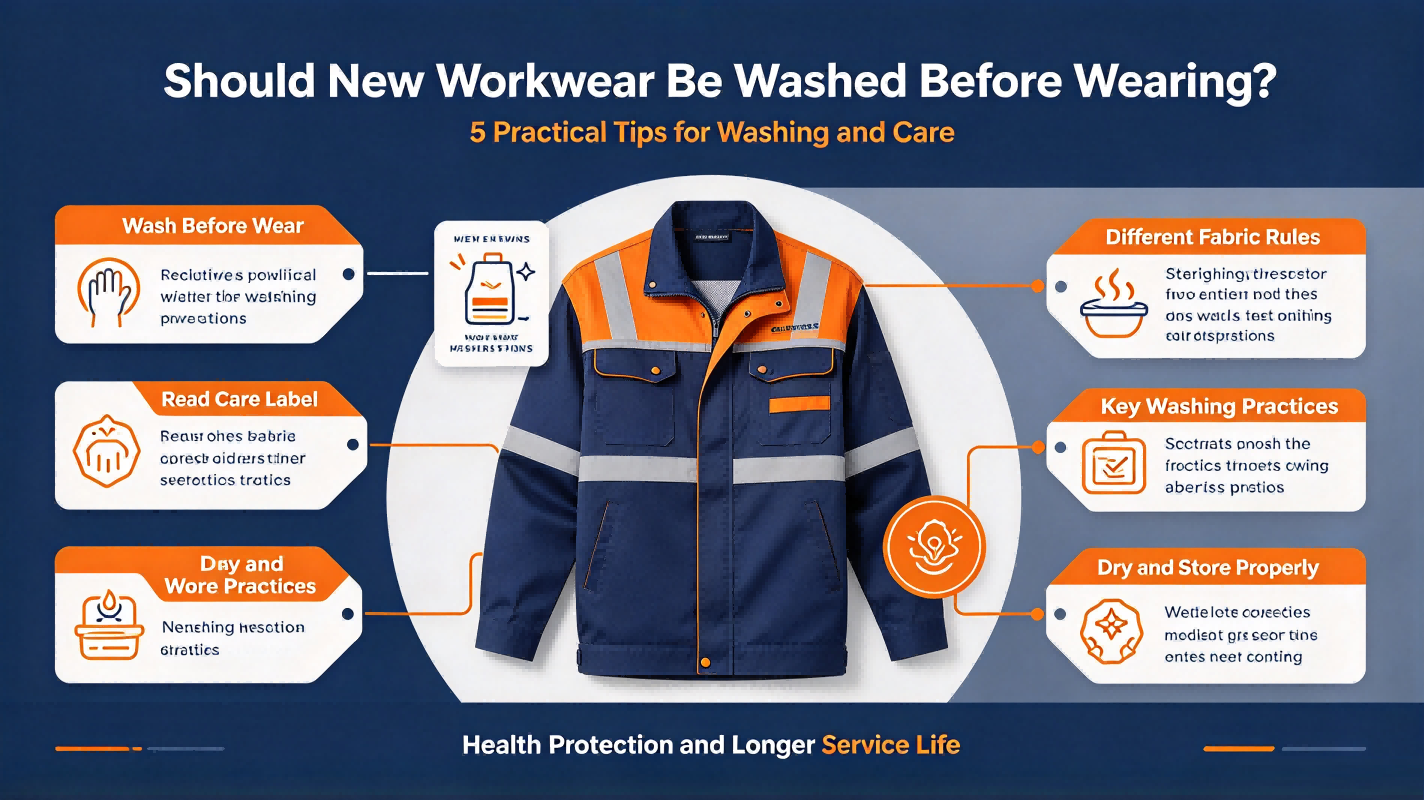
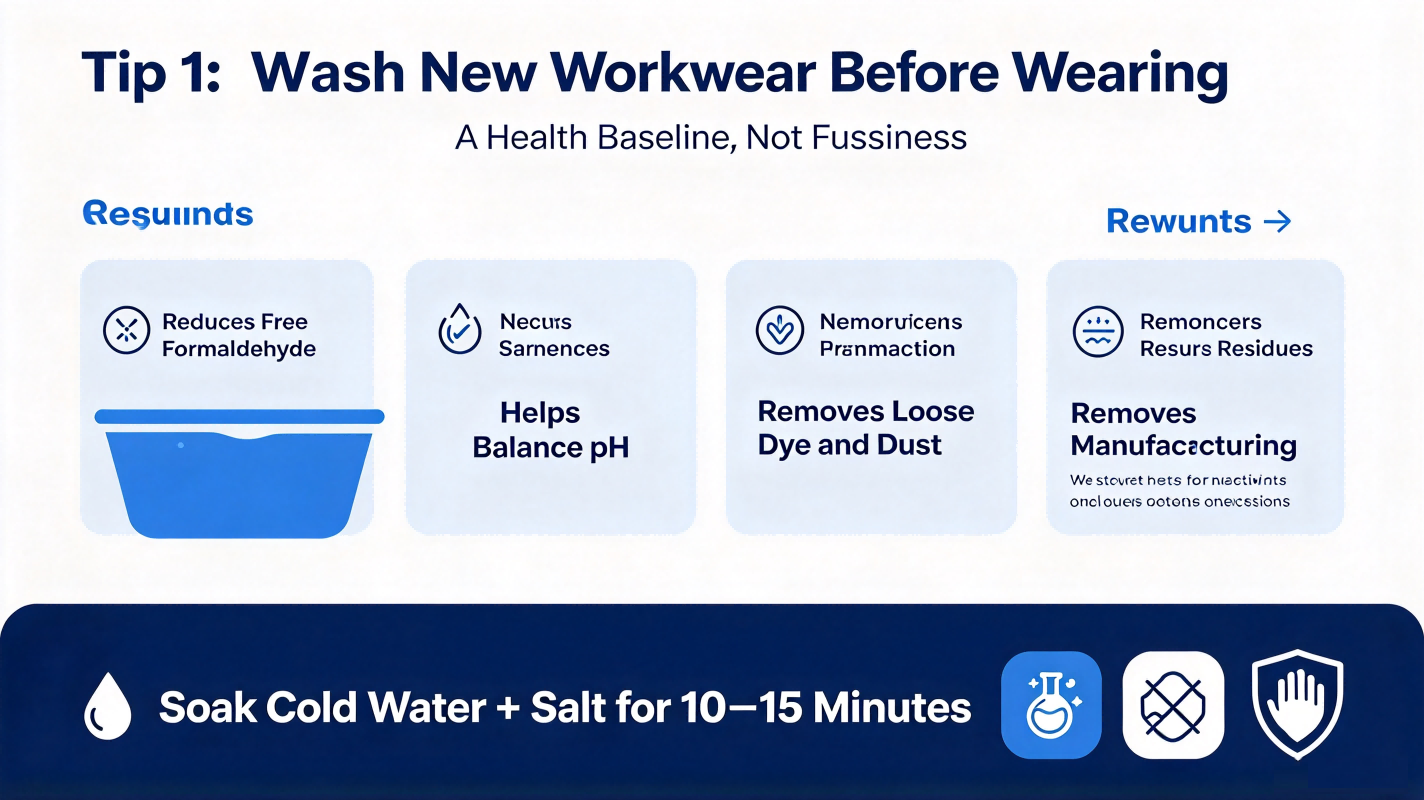
Tip 1: Always wash new workwear before wearing – this isn't being fussy, it's a health baseline.
Let's get straight to the point: every new work uniform must be washed before wearing.
Why?
During dyeing and finishing, all kinds of chemical auxiliaries are used – fixing agents, anti-wrinkle agents, softeners, anti-static agents, and more. These residues can contain free formaldehyde, out-of-range pH substances, and migratable fluorescent brighteners, among other things. When worn directly against the skin, these chemicals can be absorbed through skin contact and may cause allergies, itching, or rashes.
According to GB 18401-2010 "National General Safety Technical Code for Textile Products", products that come into direct contact with skin must meet at least Class B requirements: formaldehyde content ≤ 75 mg/kg, pH value between 4.0 and 8.5. Products not in direct contact with skin must meet at least Class C. But "meeting the standard" doesn't mean "clean" – the fabric can still have loose dye, dust, and chemical residues.
What does washing fix?
First, it removes free formaldehyde. Formaldehyde is water-soluble – one wash gets rid of most of it.
Second, it neutralises pH. New fabrics can be too acidic or too alkaline. Washing brings the pH back towards the mildly acidic range that matches human skin.
Third, it washes away loose colour and dust. Dark workwear may bleed a little on the first wash – that's normal. Washing removes surface dye that could otherwise transfer onto the skin.
Fourth, it removes manufacturing residues. From cutting to sewing to packing, the garment has passed through many hands and sat in warehouses for who knows how long.
How to do it: Soak new workwear in cold water with a little salt for 10–15 minutes, then wash as normal with neutral detergent. You can also soak in warm water with a little baking soda, then wash as normal. Hang to dry in a ventilated area.
One-line summary: washing new workwear before wearing is the simplest and most effective health protection measure.
Tip 2: Read the care label – don't just wash it any old way.
Every work uniform has a permanent care label sewn inside, with the manufacturer's washing recommendations. A lot of people never look at it – they just toss it in the machine and hope for the best. That's one of the biggest mistakes you can make.
The care label usually shows five things: washing method, bleaching, drying, ironing, and professional textile care. They're shown as symbols, not words – but most tags also have text explanations nearby.
Key symbols to know:
- A tub symbol: machine washable. The number inside is the maximum water temperature (e.g. 40 means 40℃).
- A line under the tub: gentle cycle.
- A triangle: bleach allowed. A cross through the triangle means no bleach.
- A square with a circle inside: tumble drying allowed. Crossed out means no tumble drying.
- An iron symbol: ironing allowed. Dots indicate temperature (1 dot = 110℃, 2 dots = 150℃, 3 dots = 200℃).
Why the label matters: different fabrics and different functional workwear need completely different washing routines. Ignore the label, and shrinkage, fading, deformation, and functional failure are your own doing.
For example, if the care label on anti-static workwear clearly says "no fabric softener" and you use it, the anti-static function may be ruined after just one wash. If flame-retardant workwear says "no chlorine bleach" and you use chlorine bleach, the flame-retardant finish is directly destroyed.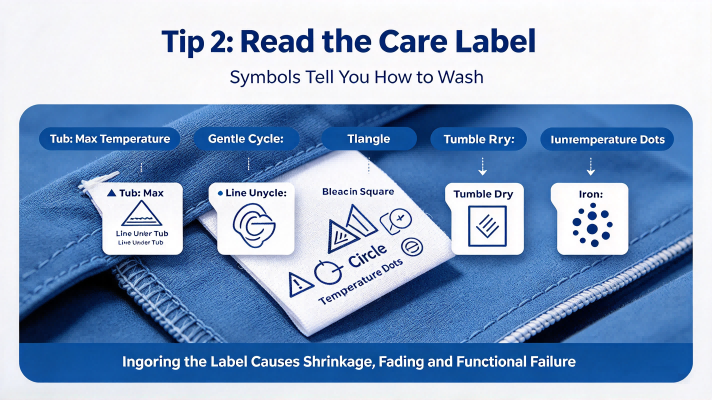
Tip 3: Different fabrics need different washing methods – cotton, poly-cotton, CVC, and functional workwear each have their own rules.
Work uniforms come in different fabrics, and their washing needs are worlds apart.
100% cotton workwear (summer T-shirts, shirts, food workshop uniforms):
Cotton breathes and absorbs sweat, but it shrinks, wrinkles, and dries slowly. Wash in cold water or lukewarm below 30℃, use neutral detergent – avoid strong alkaline washing powder. Choose the "gentle" or "cotton/linen" cycle on your machine. After washing, don't wring it out – gently press out the water instead. When drying, turn the garment inside out and hang in a shaded, ventilated area – never in direct sunlight.
Poly-cotton workwear (TC 65/35, spring/autumn jackets, trousers):
Poly-cotton is durable and wrinkle-resistant, but less breathable. Wash in lukewarm water around 30℃ or cold water – avoid high temperatures that can cause shrinkage, fading, or pilling. A normal machine cycle is fine, but avoid chlorine bleach. Don't soak for long periods – over 30 minutes can cause dye back-staining.
CVC workwear (60/40, admin, reception, maintenance inspection):
CVC's comfort is close to cotton, and it's more wash-resistant than cotton. Use cold water or below 30℃, neutral detergent, gentle or standard machine wash. Turn inside out to reduce surface friction and protect colour and hand-feel. Shade dry, turned inside out.
Anti-static workwear (electronics, chemicals, petrochemicals):
The core of anti-static workwear is the conductive filaments in the fabric. Once the filaments break, the anti-static function fails. Wash at below 40℃ with neutral detergent. Absolutely no fabric softener – softener forms an insulating layer on the conductive fibres, directly destroying anti-static performance. No chlorine bleach, no high-heat tumble drying. Wash separately, or with similar anti-static workwear. Anti-static workwear should be retested for surface resistance every 6 to 12 months; if it falls outside the range specified in GB 12014-2019, replace it.
Flame-retardant workwear (welding, metallurgy, chemicals, power):
Flame-retardant workwear comes in inherent and treated types. For treated flame-retardant workwear, washing methods directly affect the flame-retardant lifespan. Water temperature below 40°C, neutral detergent, no chlorine bleach, no fabric softener. Treated flame-retardant workwear should be sent for testing after 30 to 40 washes to confirm flame-retardant performance. Inherent flame-retardant workwear is more wash-resistant, but still avoid high-heat drying and strong mechanical action.
Moisture-wicking quick-dry workwear (summer outdoor, high-temperature workshops):
Moisture-wicking relies on profiled fibre cross-sections and capillary action. No fabric softener, no alkaline washing powder, no long soaking, no high-heat tumble drying. Evaluated according to GB/T 21655.1-2023, it must meet water absorption rate, drop diffusion time, and drying rate indicators both before and after washing. If it fails after a few washes, it doesn't meet the standard.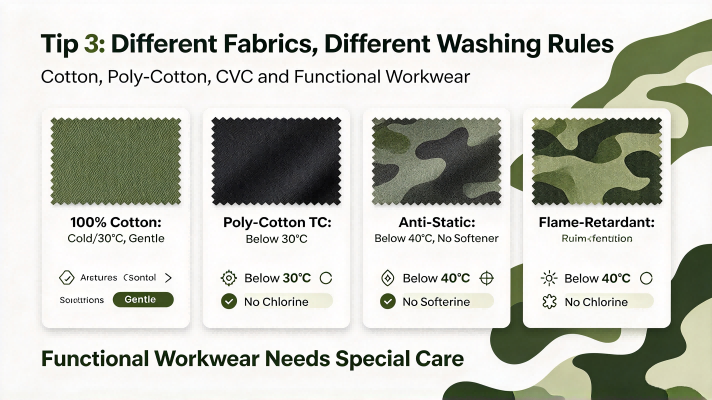
Tip 4: The little details in washing make all the difference – 5 key practices.
1. Wash dark and light colours separately. Keep whites and pastels away from dark navy and black to prevent dye transfer. White workwear is best washed on its own.
2. Pre-treat collars and cuffs. Collars and cuffs are the dirtiest parts. Before washing, rub a little soap or neutral detergent directly onto these areas, leave for 5 to 10 minutes, then wash as usual. This works much better than just throwing them straight in the machine.
3. Turn inside out and use a laundry bag for machine washing. Turn the uniform inside out before putting it in the machine – this reduces direct friction on the outer surface, protecting fibres and prints. Cuffs, collars, and other high-wear areas can go in a fine-mesh bag.
4. Control the water temperature. For coloured workwear, always use cold water. Hot water speeds up dye loss and is the number one killer causing shrinkage and deformation. Don't soak for more than 30 minutes, and never soak in water above 30℃ for a long time.
5. No bleach, and no fabric softener for functional workwear. Chlorine bleach damages fibres, causes fading, and destroys flame-retardant and anti-static functions. For whitening white workwear, use oxygen-based bleach (colour-safe bleach), and follow the instructions carefully. For anti-static, flame-retardant, and moisture-wicking workwear, never use fabric softener.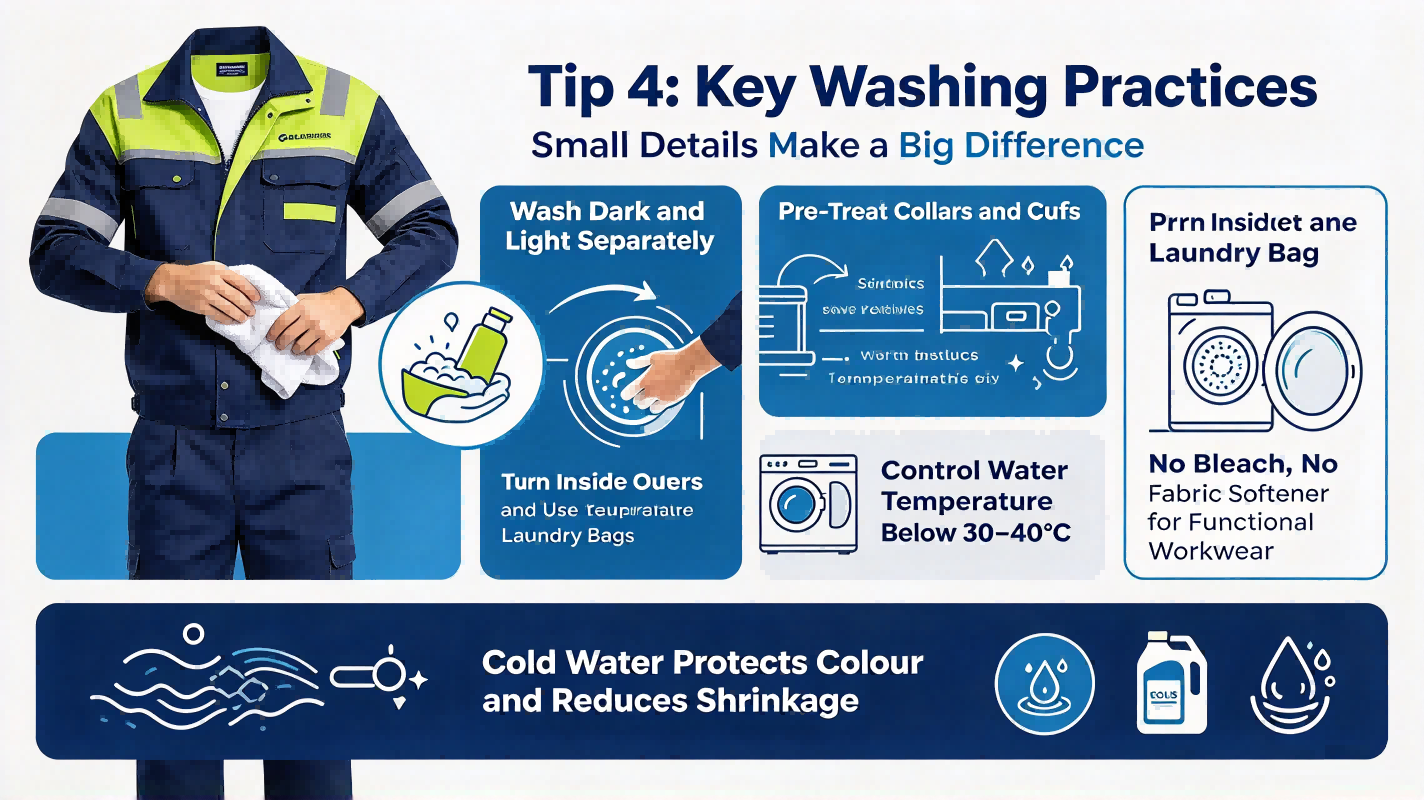
Tip 5: Drying and storing – the last two steps are the ones most often overlooked.
Washing well is only half the battle – drying matters just as much. A lot of workwear isn't ruined by washing; it's ruined by bad drying.
Three rules for drying:
1. Dry in the shade, not in direct sun. Direct sunlight is the number one enemy of colour retention. Hang uniforms in a shaded, ventilated spot to dry naturally. For dark-coloured or printed workwear, turn them inside out before hanging.
2. Skip the tumble dryer. Unless the care label explicitly says it's safe, most workwear fabrics will shrink, deform, or pill in a dryer. Flame-retardant and anti-static workwear are especially not recommended for high-heat tumble drying.
3. Gently pull it into shape when half-dry. Cotton workwear wrinkles easily. When the garment is no longer dripping but still damp, gently pull the collar, front placket, cuffs, and trouser seams into shape – it'll dry much smoother. Knitted workwear should be laid flat to dry – hanging can stretch and deform it.|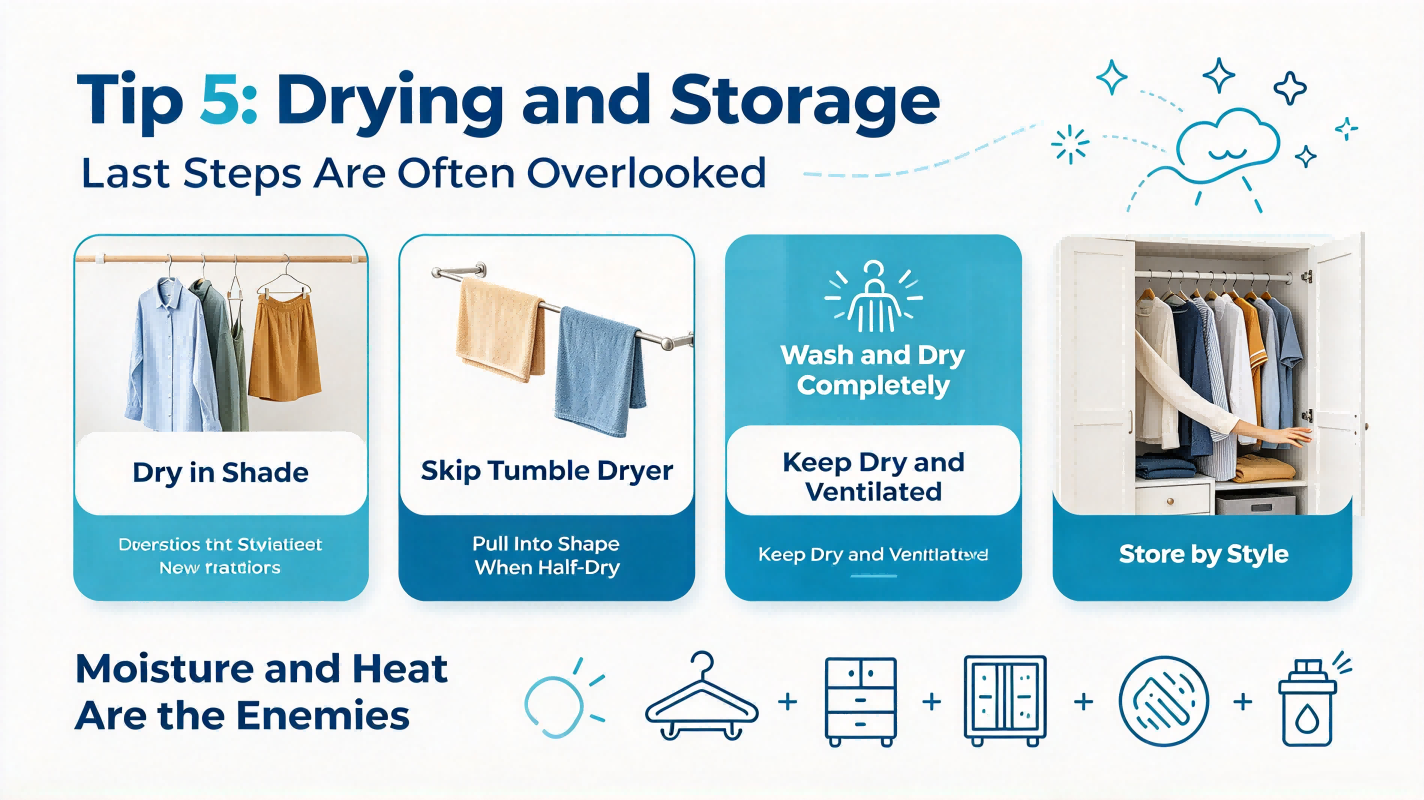
Three rules for storage:
1. Wash and dry it completely before storing. Any leftover moisture or stains can become a breeding ground for mildew.
2. Keep it dry and ventilated. Put moisture absorbers (silica gel packs) or moth repellents (camphor balls) in the wardrobe or warehouse – but make sure the repellents don't touch the clothes directly.
3. Store different styles differently. Summer workwear can be folded; blazers and shirts are best hung on hangers. For shell jackets and anti-static workwear, confirm they're dry before storing, avoid heavy pressure, and prevent damage to functional layers.
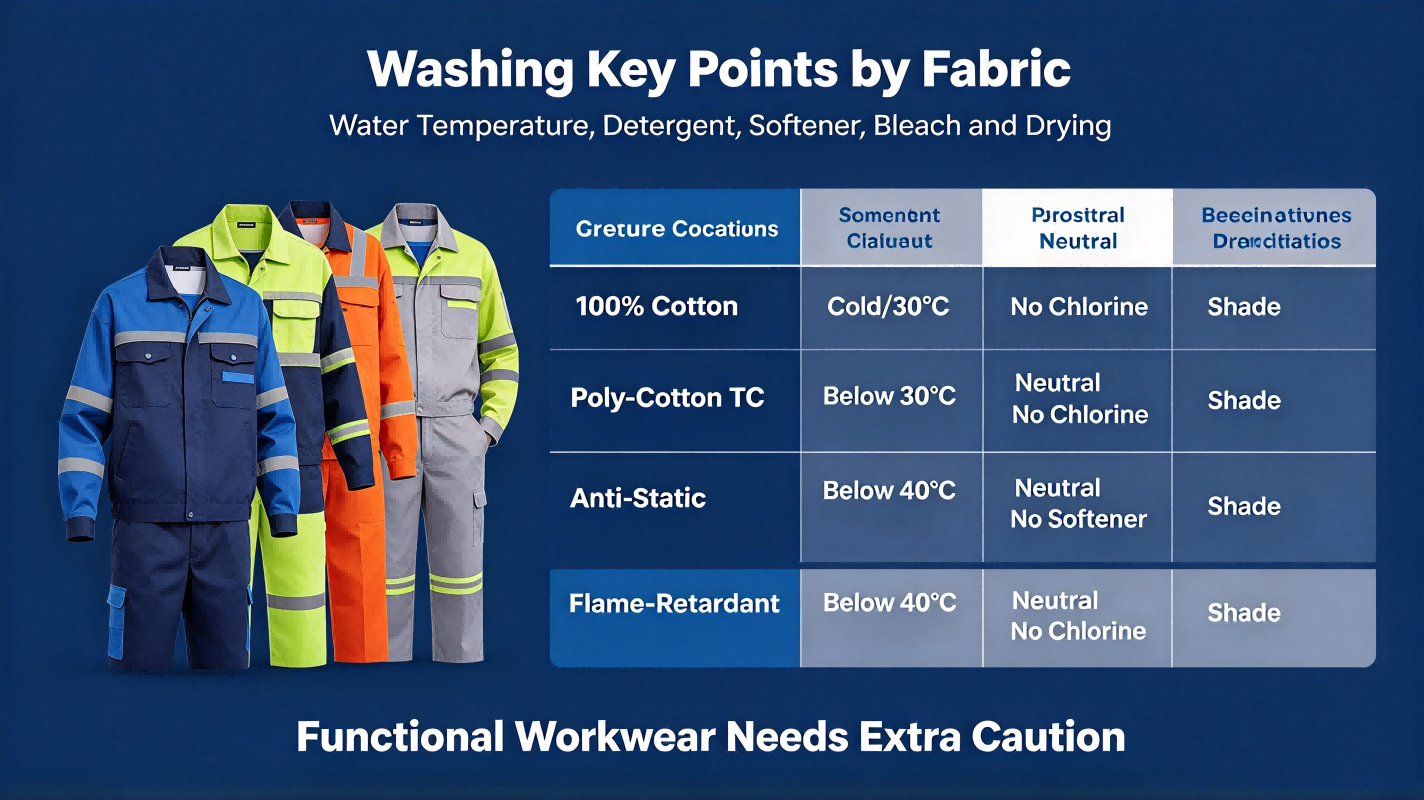
A summary table: washing key points for different workwear
| Fabric type | Water temp | Detergent | Fabric softener | Bleach | Drying |
| 100% cotton | Cold/30℃ | Neutral | OK (use sparingly) | Not recommended | Inside out, shade |
| Poly-cotton TC | Below 30℃ | Neutral | OK (use sparingly) | No chlorine | Shade |
| CVC | Cold/30℃ | Neutral | OK (use sparingly) | No chlorine | Inside out, shade |
| Anti-static | Below 40℃ | Neutral | Do not use | No chlorine | Shade |
| Flame-retardant | Below 40℃ | Neutral | Do not use | No chlorine | Shade |
| Moisture-wicking | Cold/30℃ | Neutral | Do not use | No chlorine | Ventilated shade |
| Knitted/woollen | Cold hand wash | Neutral | Use sparingly | No | Lay flat, shade |
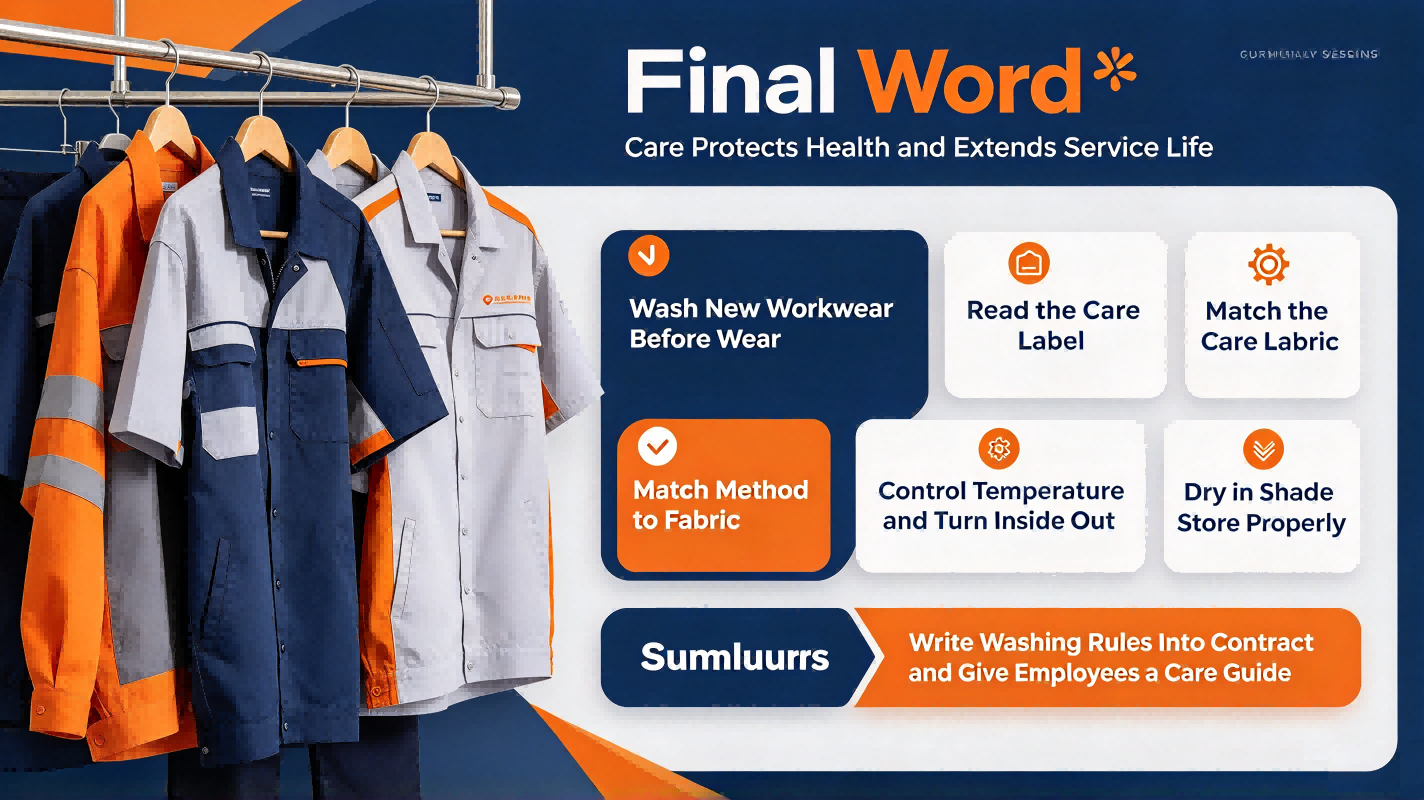
A final honest word
Workwear is labour equipment that employees wear every day and wash every week. Getting the care routine right directly affects two things: employee skin health, and how long the workwear actually lasts.
Wash new workwear before wearing it – that's the absolute minimum. For day-to-day care, check the label, separate colours, control water temperature, turn inside out, dry in the shade, and no fabric softener for functional workwear. Do these, and your workwear will easily last an extra season or two.
During procurement, write shrinkage rate, colour fastness, and washing methods into the contract and technical specification sheet. When distributing, give employees a simple care guide. During use, remind employees to wash and care according to fabric type.
Don't think of it as a chore. A few extra minutes of doing it right every day saves you far more money and hassle than repeatedly buying new workwear.