O que você está procurando?

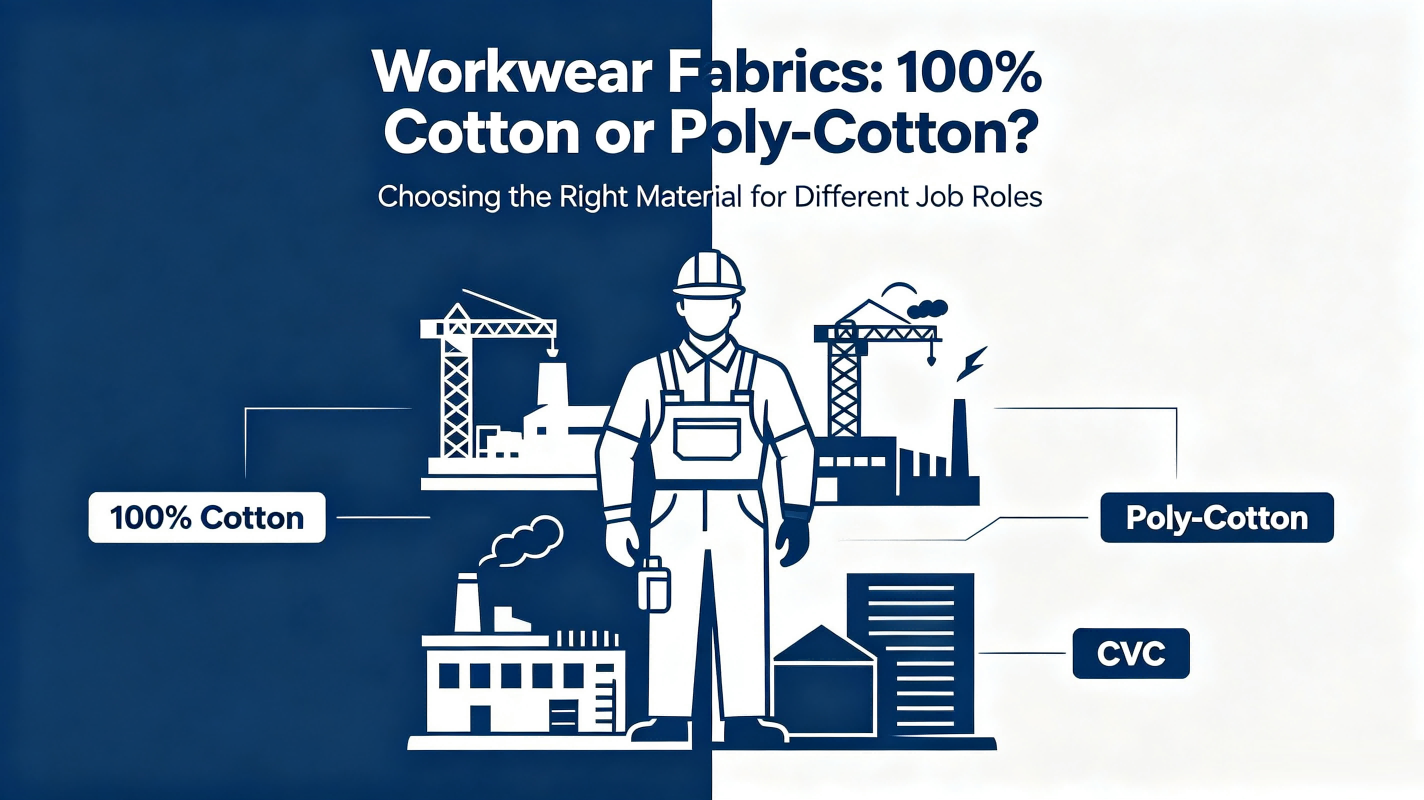
Anyone who buys workwear has probably been stuck on this question at some point—should I go with 100% cotton or a poly-cotton blend?
Some say cotton is comfortable and breathable—workers feel better in it. Others say poly-cotton is tough, easy to wash, and better value. Both sides have a point. But here's the thing—workwear isn't a casual shirt for yourself; it's protective gear for people doing different jobs. The demands of a welder, a warehouse worker, and a receptionist are completely different. Pick the wrong fabric, and your workers suffer while you waste money.
Today, we're going to break down these two mainstream workwear fabrics—100% cotton and poly-cotton—in terms of composition, performance, and cost, and which jobs they're best for. After reading this, you'll know exactly what to choose.
First, 100% cotton: comfortable, yes – but don't use it in the wrong places
100% cotton is a fabric made entirely from cotton fibres. Its benefits are well known.
Breathability and moisture absorption are cotton's biggest strengths. Cotton fibres are naturally hollow, allowing air to circulate freely and heat to dissipate. Cotton can absorb a significant percentage of its own weight in moisture, pulling sweat away from the skin and keeping the surface relatively dry. In light-duty, air-conditioned environments like offices or front desks, cotton workwear feels genuinely good.
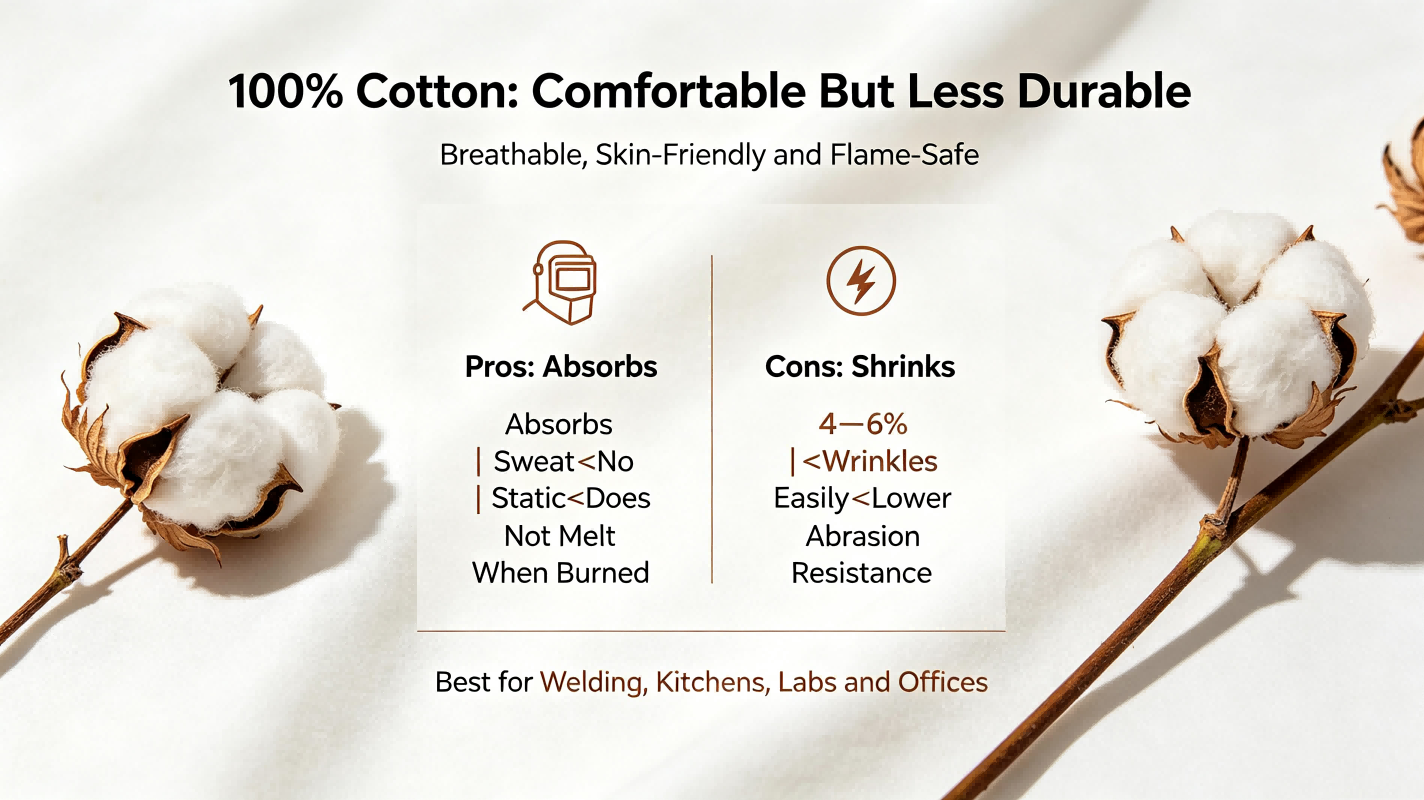
Skin-friendly and static-free. Cotton is a natural fibre—it doesn't irritate skin, even for sensitive types. And it doesn't generate static electricity, so no annoying zaps in dry conditions.
Cotton doesn't stick to the skin when burned. This is critical in jobs with open-flame risks (welding, hot work). Synthetic fibres melt and fuse to the skin when heated, causing worse burns. Cotton turns to ash and falls away.
But cotton has obvious downsides too.
First, high shrinkage. Pure cotton shrinks 4–6% after standard washing. A properly sized garment can be a full size smaller after just a few washes, throwing off bulk orders. When buying 100% cotton workwear, you must factor shrinkage into the pattern—sizing up by 1–2 sizes is recommended.
Second, it wrinkles easily. Wear it for a day without ironing and it looks like a rag. Workers in wrinkled uniforms don't do your company's image any favours.
Third, not very durable. Cotton's abrasion resistance is weaker than poly‑cotton blends. In high‑wear environments like machine shops or logistics, its service life is typically only about 60% that of poly‑cotton. After six months, collars and cuffs look worn and faded, and trouser hems thin out faster.
Fourth, slow to dry. Cotton absorbs moisture well, but releases it slowly. In high-sweat situations, a cotton uniform gets soaked and stays damp for a long time. During rainy seasons, it might not dry overnight—leaving workers with nothing to wear the next day.
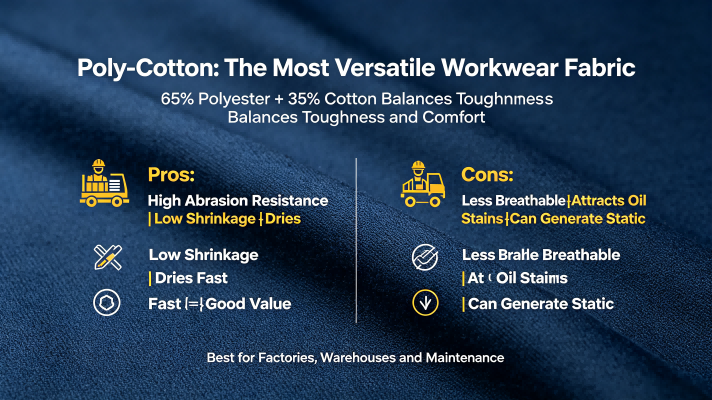
Which jobs are 100% cotton best for?
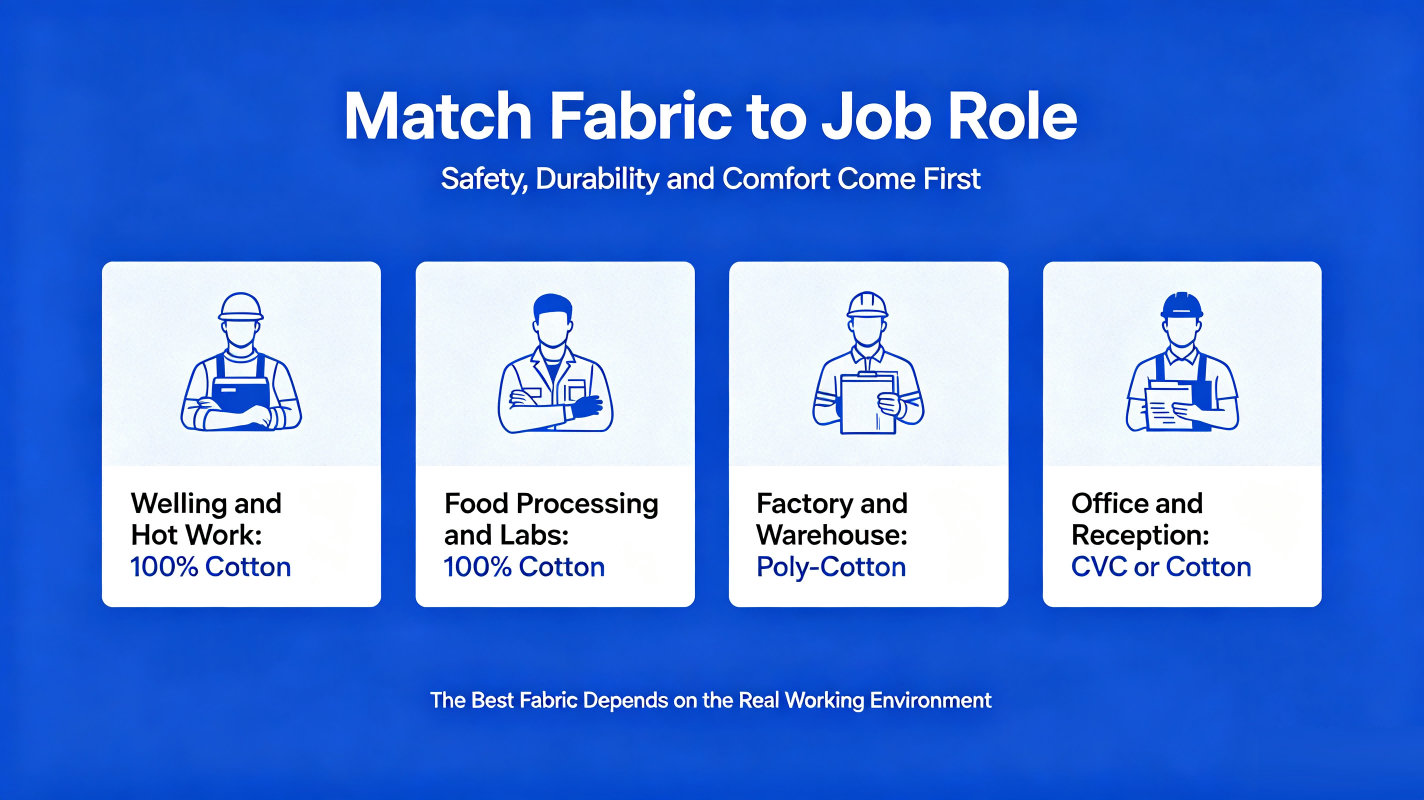
Food processing and commercial kitchens – synthetic fibres are restricted in food areas because they can shed microfibres, posing a contamination risk. Kitchens also have open flames, and polyester would melt onto the skin if heated.
Hospital cleaning staff and lab technicians – they handle chemicals; cotton absorbs well and doesn't generate static.
Welding and hot work – open‑flame risks; cotton doesn't melt or stick, making it safer.
Offices, reception desks – light duty, air‑conditioned, image‑conscious – cotton's comfort and appearance are ideal.
What to watch for when buying 100% cotton workwear: Choose combed cotton with a yarn count of at least 32s and a density of 110×70 or higher. Low‑count coarse yarn cotton feels stiff and uncomfortable. Price‑wise, a full cotton work set runs about 65–110 yuan per set; combed, high‑density sets may exceed 120 yuan
Now, poly‑cotton: the most versatile workwear fabric and the best value
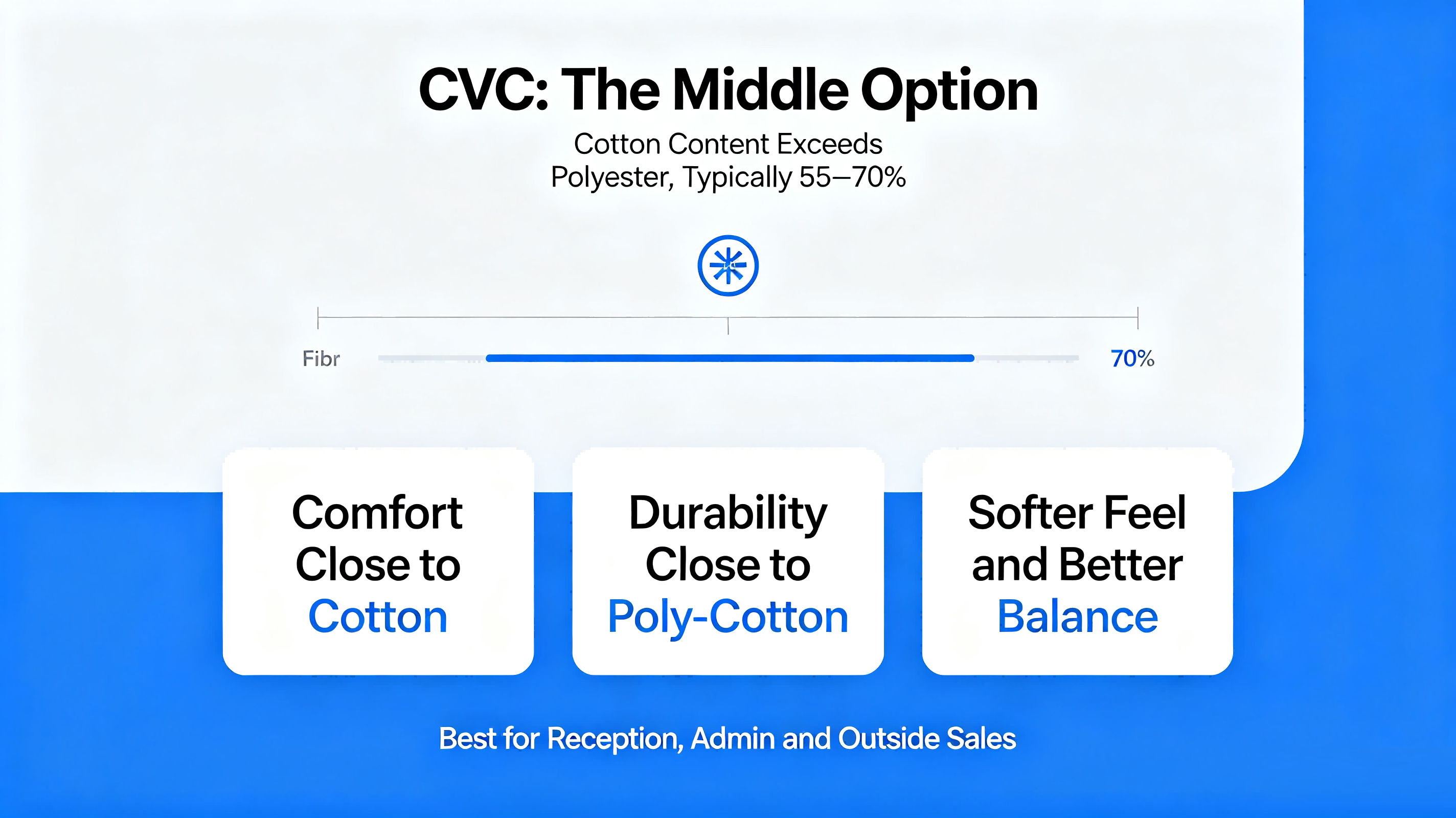
Poly-cotton is a blend of polyester and cotton. The most common ratio in workwear is 65% polyester + 35% cotton. The polyester provides the "backbone"—abrasion resistance, wrinkle resistance, and shape retention. The cotton provides the "soul"—retaining some breathability and moisture absorption.
The advantages of poly-cotton are very real.
Abrasion resistance and wrinkle resistance are its biggest selling points. Poly-cotton withstands Martindale abrasion up to 25,000 cycles—nearly 40% more than pure cotton (18,000 cycles). It doesn't pill easily, holds its shape after washing, and needs little to no ironing.
Very low shrinkage. Poly-cotton shrinks only about 2.1% after standard washing. Buy the right size and it stays that way – no sudden loss of length.
Dries fast. Polyester doesn't absorb water – sweat sits on the surface and evaporates much more quickly. Under the same conditions, a cotton T-shirt might take 1–2 hours to dry, while a poly-cotton T-shirt takes about 30–40 minutes to feel dry.
Great value for money. Poly-cotton fabric costs 20–30% less than pure cotton. A 220gsm 65/35 poly-cotton twill costs about 12–16 yuan per metre, versus 20–35 yuan for pure cotton. A full poly-cotton work set typically runs 55–95 yuan per set; bulk orders of 300+ can go down to 50–80 yuan.
But poly-cotton has downsides too.
It is less breathable than cotton. The higher the polyester ratio, the less air permeability. In hot, sweaty conditions, it can feel stuffier. But unless your workers are in extreme outdoor heat, poly-cotton performs well enough for most jobs.
Attracts oil stains. Polyester is hydrophobic and has an affinity for oils—oil stains are harder to wash out than on cotton.
Prone to static. Polyester is synthetic and can generate static in dry weather. For jobs requiring anti-static protection (electronics workshops, petrochemicals), you need specialised anti-static fabrics, not standard poly-cotton.
Low-quality poly-cotton can pill. Cheap blends may develop fuzz balls with wear.
Which jobs are poly-cotton best for?
Factory assembly line workers, warehouse pickers, maintenance technicians, construction site support staff. These jobs involve heavy activity, high abrasion, and frequent washing (2–3 times a week)—poly-cotton's toughness and wrinkle resistance are a perfect match.
For standard workshop roles, choose TC (poly-cotton) blends—they're durable and cost-effective.
What to watch for when buying poly-cotton workwear: For spring/autumn, choose 240–260 gsm; for summer, lightweight versions drop to 200–220 gsm. The 65/35 poly-cotton blend is the most widely used workwear fabric in China—balanced performance at a friendly price.
There's also a middle option: CVC fabric
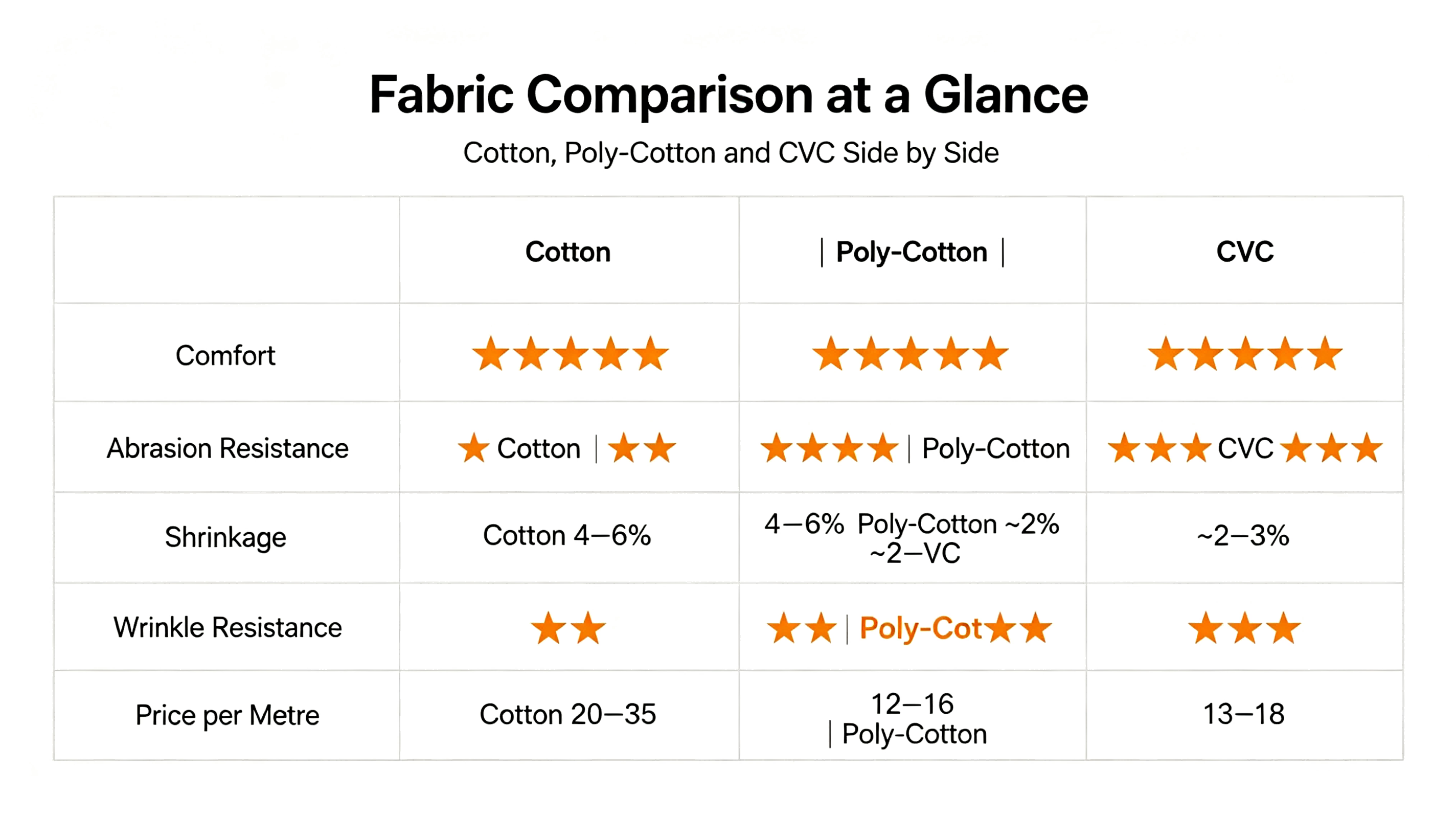
Besides pure cotton and poly-cotton, there's another common workwear fabric called CVC. CVC stands for Chief Value Cotton—it's still a poly-cotton blend, but the cotton content exceeds polyester, typically between 55% and 70%.
CVC sits between pure cotton and poly‑cotton in performance – comfort close to cotton, durability close to poly‑cotton. It shrinks less, resists wrinkles, and feels softer than regular poly‑cotton. Price is also in the middle – 220gsm CVC twill runs about 13–18 yuan per metre.
Which jobs suit CVC? Roles where comfort is a higher priority – receptionists, administrative staff, outside sales reps. If a job involves both air‑conditioned indoors and occasional outdoor activity, CVC strikes a good balance.
How to choose? A simple comparison table
| Feature | 100% Cotton | Poly‑Cotton (65/35) | CVC (60/40) |
| Cotton content | 100% | 35% | 60–70% |
| Comfort | ★★★★★ | ★★★ | ★★★★ |
| Abrasion resistance | ★★★ | ★★★★★ | ★★★★ |
| Shrinkage rate | 4–6% | ~2% | ~2–3% |
| Wrinkle resistance | ★★ | ★★★★★ | ★★★★ |
| Drying speed | ★★ | ★★★★★ | ★★★★ |
| Price (yuan/metre) | 20–35 | 12–16 | 13–18 |
| Full set price (yuan) | 65–110 | 55–95 | 85–110 |
A few common pitfalls – know them before you buy
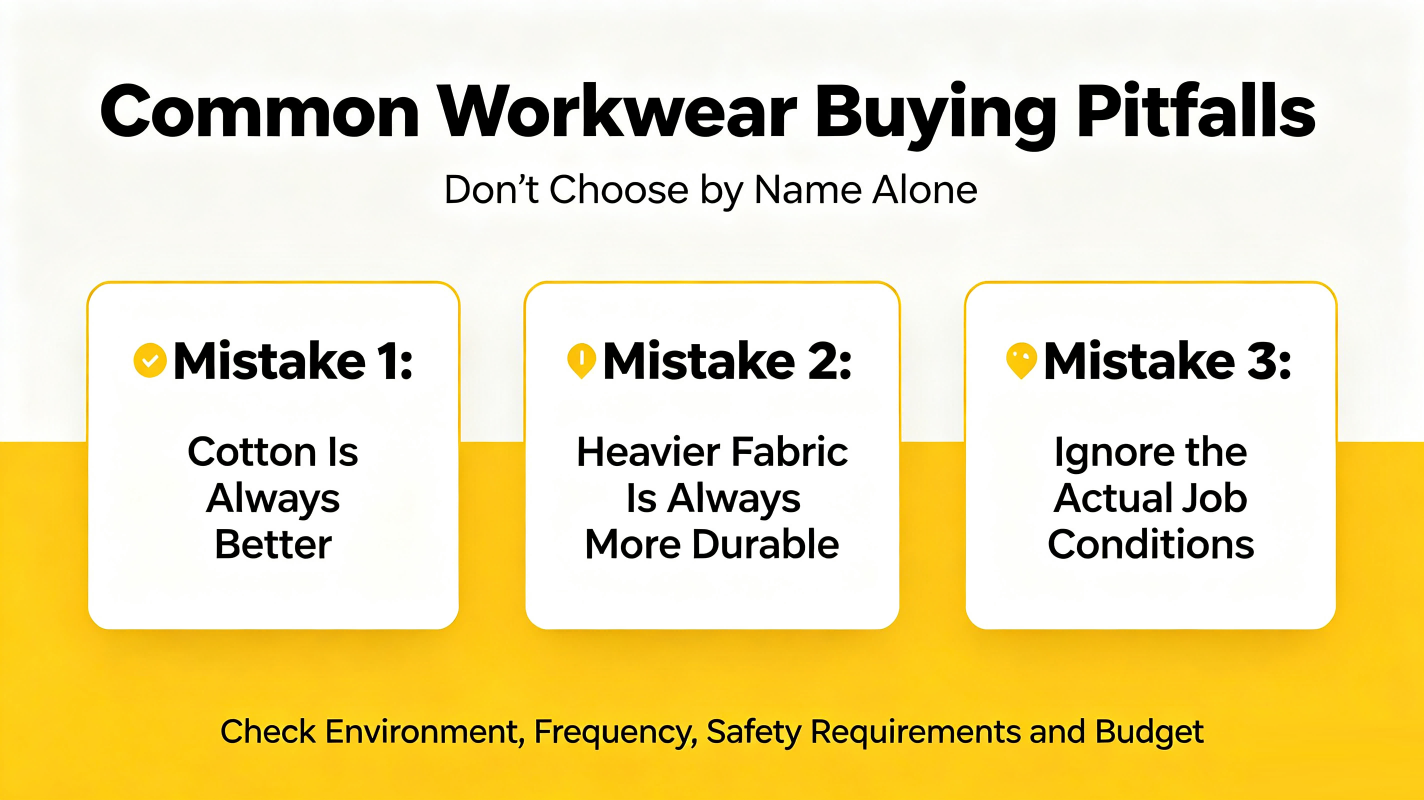
Mistake 1: "Cotton is always better than blends." This is the most widespread misunderstanding in workwear procurement. Workwear isn't casual clothing—it has to withstand heavy friction, pulling, and frequent washing. Cotton's weaknesses are obvious in these conditions. In most workshop settings, poly-cotton is actually the better choice. Only in high-heat or open-flame jobs does cotton's non-melting, non-sticking property become a must-have.
Mistake 2: "Heavier fabric is more durable." Fabric weight (gsm) is about thickness, not strength. Durability depends on fibre type, yarn thickness, and weave density. A 200gsm high-density fine twill poly-cotton can actually be more abrasion-resistant than a 260gsm low-density cotton twill.
Mistake 3: "Just look at the fabric name—ignore the actual job conditions." Before buying, you must understand the real working environment—indoor or outdoor? Air-conditioned? High activity? Any open-flame or chemical risks? Anti-static requirements? Don't make decisions based on fabric names alone.
One last honest word
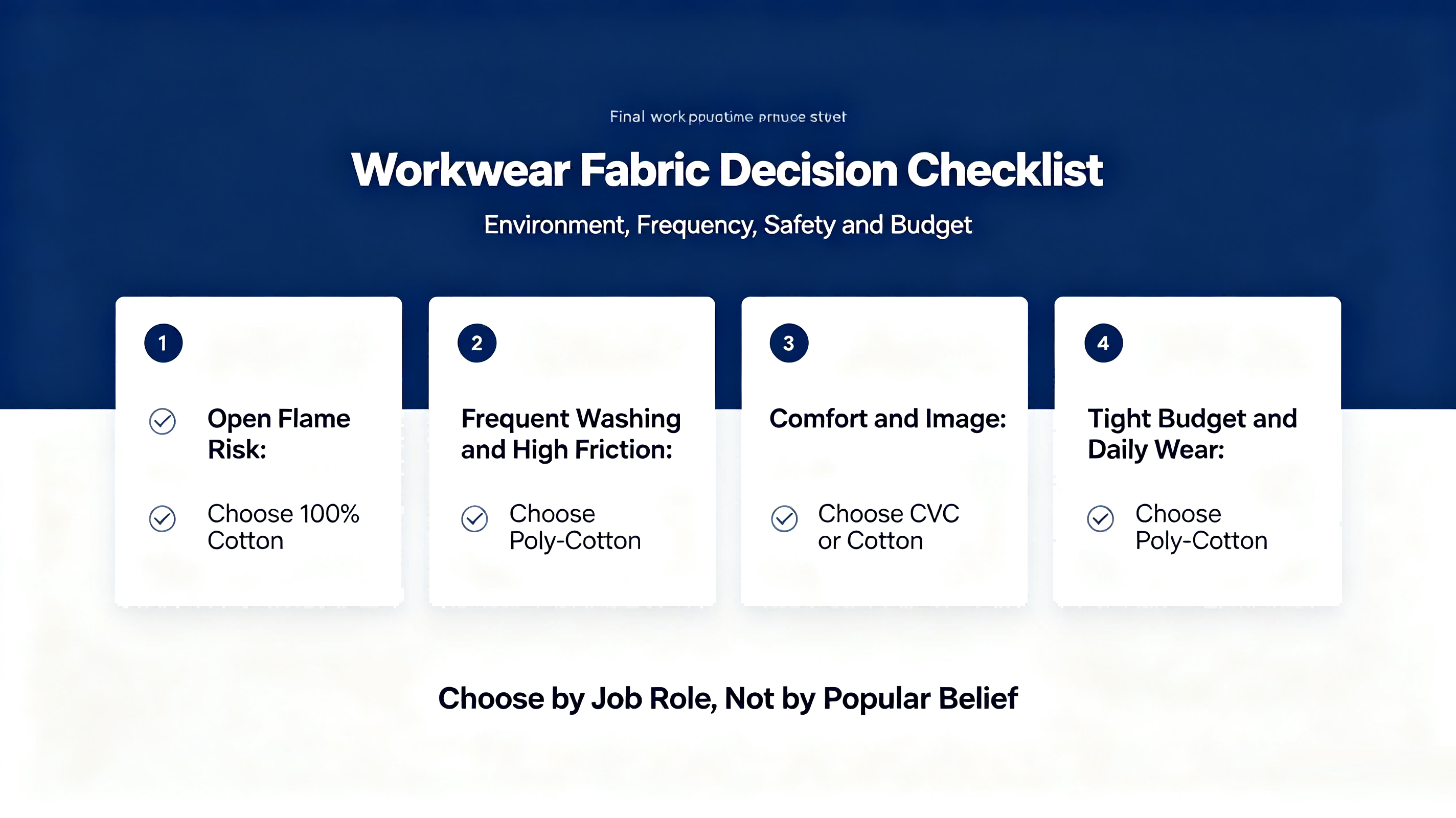
Whether to choose 100% cotton or poly-cotton for workwear—there's no single right answer. It comes down to three things: the work environment, how often it's worn, and your budget.
For jobs with open-flame risks (welding, hot work) – 100% cotton is a must. Safety first.
For food processing, hospitals, labs—100% cotton is better. Synthetic fibre shedding is a contamination risk.
For factory floors, warehouses, maintenance – poly-cotton gives the best value – tough, wrinkle-resistant, and easy to care for.
For offices, reception desks – CVC or cotton – comfort and appearance are the priority.
If your budget is tight and workers wear and wash uniforms every day, poly-cotton is the most cost-effective—durable and hassle-free.
Once you've got these principles down, the next time you're choosing workwear fabrics for your company, you'll have confidence. No more taking a supplier's word at face value—what they recommend might not be wrong, but it might not be the best fit for your actual job roles.