O que você está procurando?


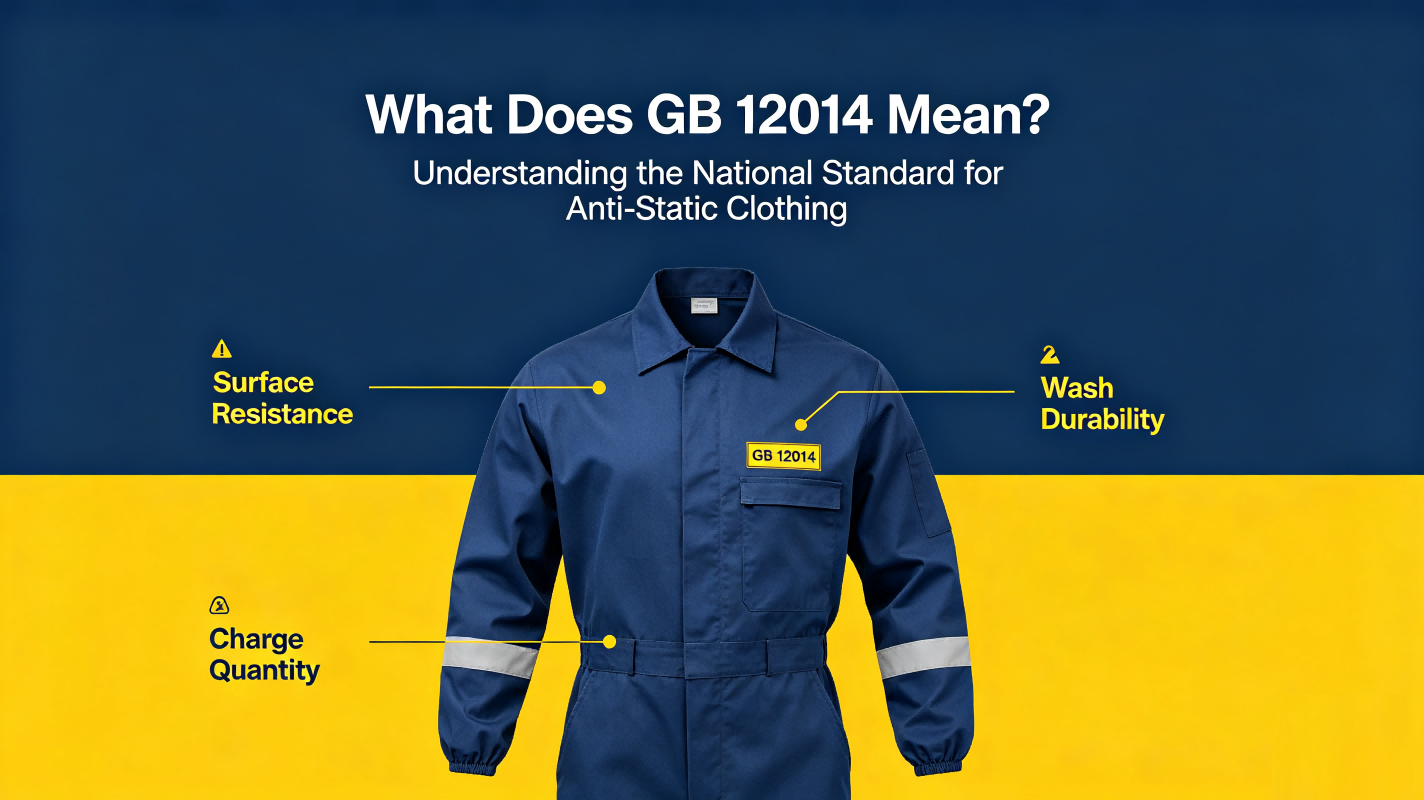
1. What is GB 12014? Why does this standard exist?
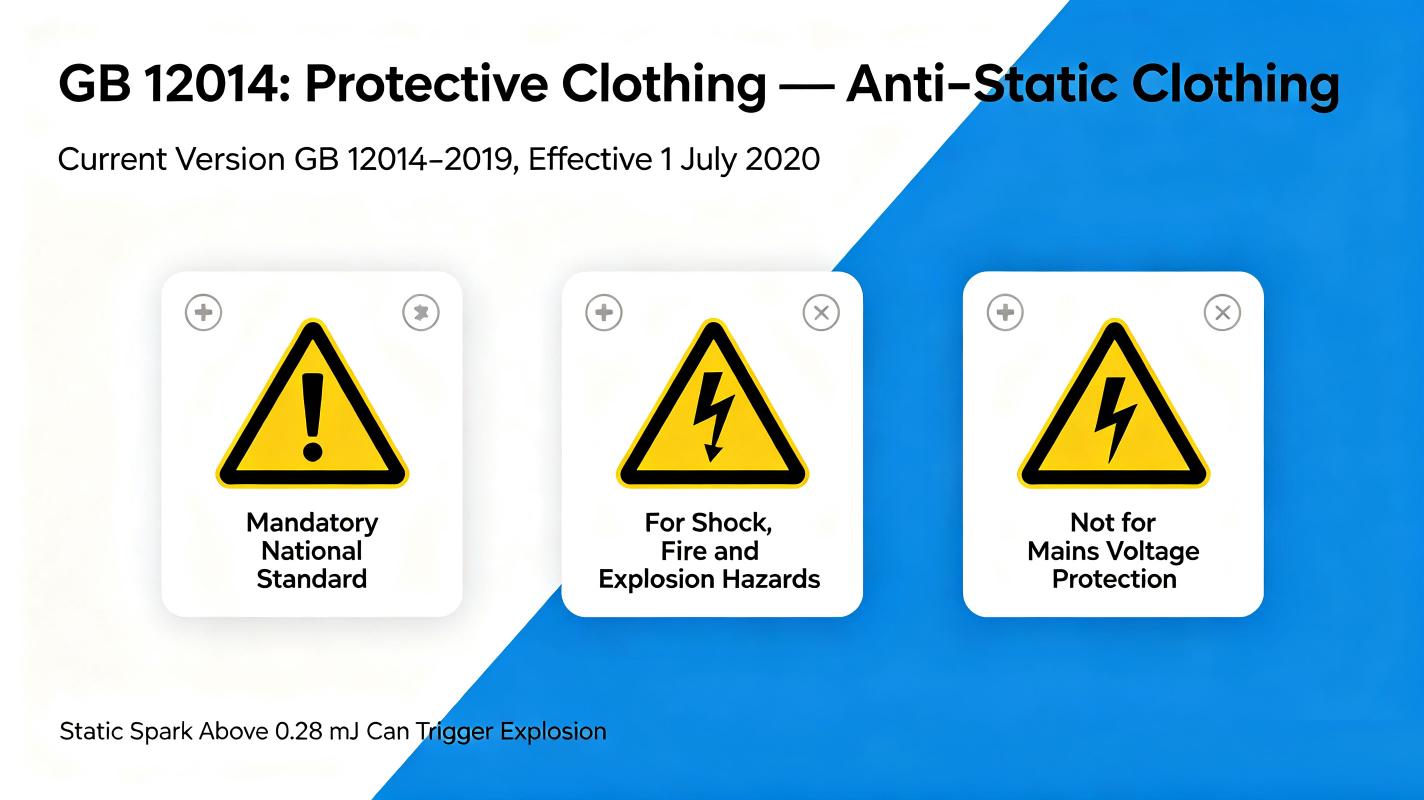
The full title of GB 12014 is "Protective clothing – Anti-static clothing." It is China's mandatory national standard for anti-static clothing. The current version is GB 12014‑2019, which came into effect on 1 July 2020, replacing the 2009 version.
This standard applies to anti-static clothing worn in locations where static electricity may cause electric shock, fire, or explosion hazards. It does not apply to non-woven anti-static clothing or anti-static clothing for protection against mains voltage.
Why does this standard exist? Because static electricity, which most people see as just a minor shock, is lethal in certain environments. In areas with high concentrations of oil-gas mixtures, a static spark with energy above 0.28 mJ can trigger an explosion. In electronics cleanrooms, just 200 V of static can punch through a chip's gate oxide layer, causing component failure. Anti-static clothing isn't something you just "put on and it works"—its performance must be rigorously tested.
GB 12014‑2019 brought several important updates over the old version: revised safety indicator requirements for fabrics, added appearance quality requirements and test methods for garments, revised sizing requirements, and integrated the former GB/T 23464 standard.
2. Core technical indicators: understand these numbers and you understand anti-static clothing
Anti-static clothing isn't about "not generating static" – it's about quickly conducting away the static that is generated, so it doesn't build up. When people walk and rub against things, static builds up on their bodies and clothes. Anti-static clothing provides an "escape route" for that static. This route relies on conductive fibres woven into the fabric.
So how do you tell if an anti-static garment is compliant? Look at the following core indicators.
Indicator 1: Surface resistance and point-to-point resistance – the measure of conductivity
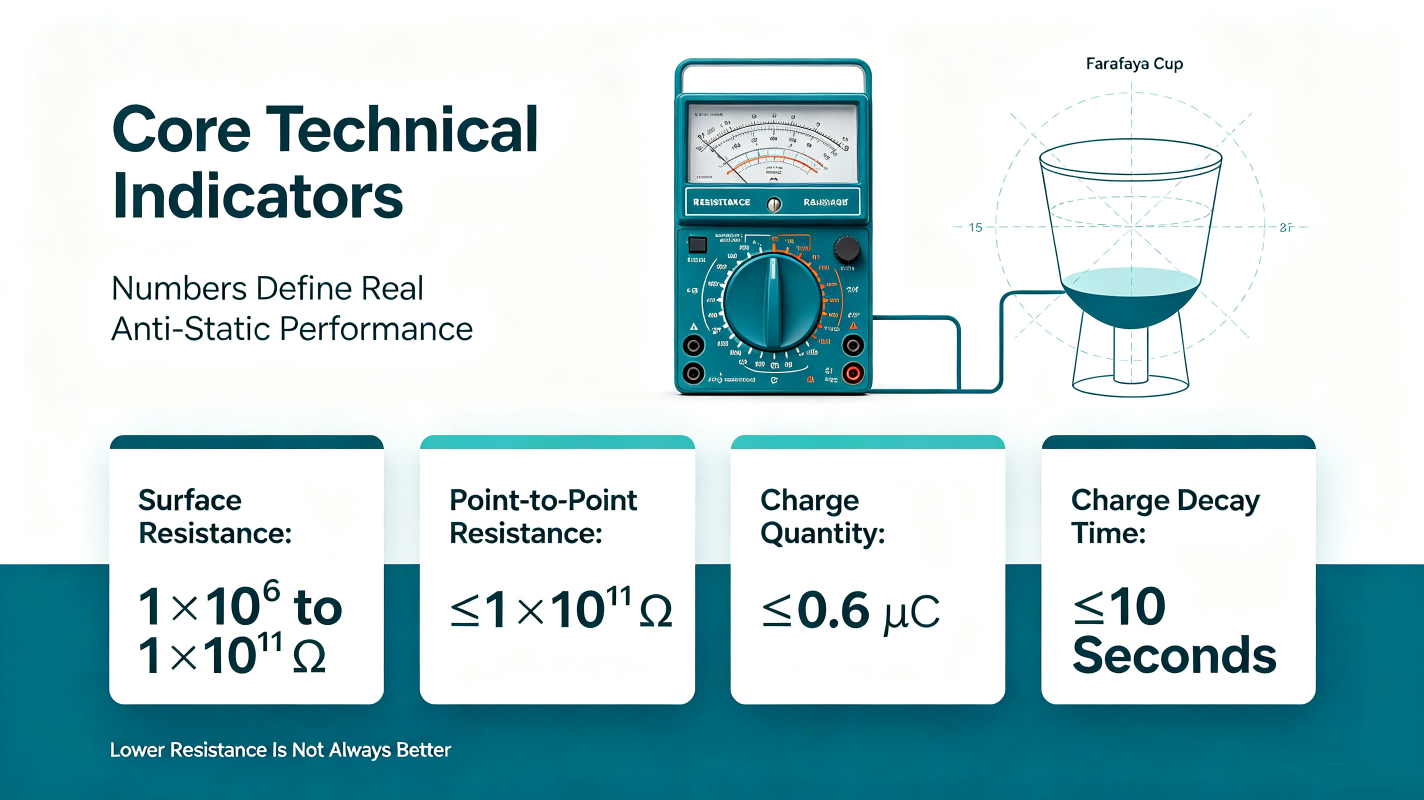
According to GB 12014-2020 (the standard has both 2019 and 2020 version numbers, with identical technical requirements), the surface resistance of the fabric should be between 1×10⁶ Ω and 1×10¹¹ Ω, the surface resistance of the finished garment should be between 1×10⁷ Ω and 1×10¹¹ Ω, and the point‑to‑point resistance should be ≤1×10¹¹ Ω.
Here's a point that's easy to misunderstand – lower resistance is not better. If resistance is too low (say, below 1×10⁵ Ω), it can actually create a shock hazard in live‑working environments. If it's too high, it won't dissipate static. The goal of anti‑static clothing is to "slowly leak static," not to turn the garment into a conductor.
Indicator 2: Charge quantity – simulating static generated by real friction
This is the indicator that comes closest to real-world use. The test method involves placing the garment in a tumble friction machine, tumbling it with a standard friction cloth for a specified time, then quickly transferring it into a Faraday cup to measure the electrostatic charge. GB 12014 requires the charge quantity of each anti-static garment to be less than 0.6 μC.
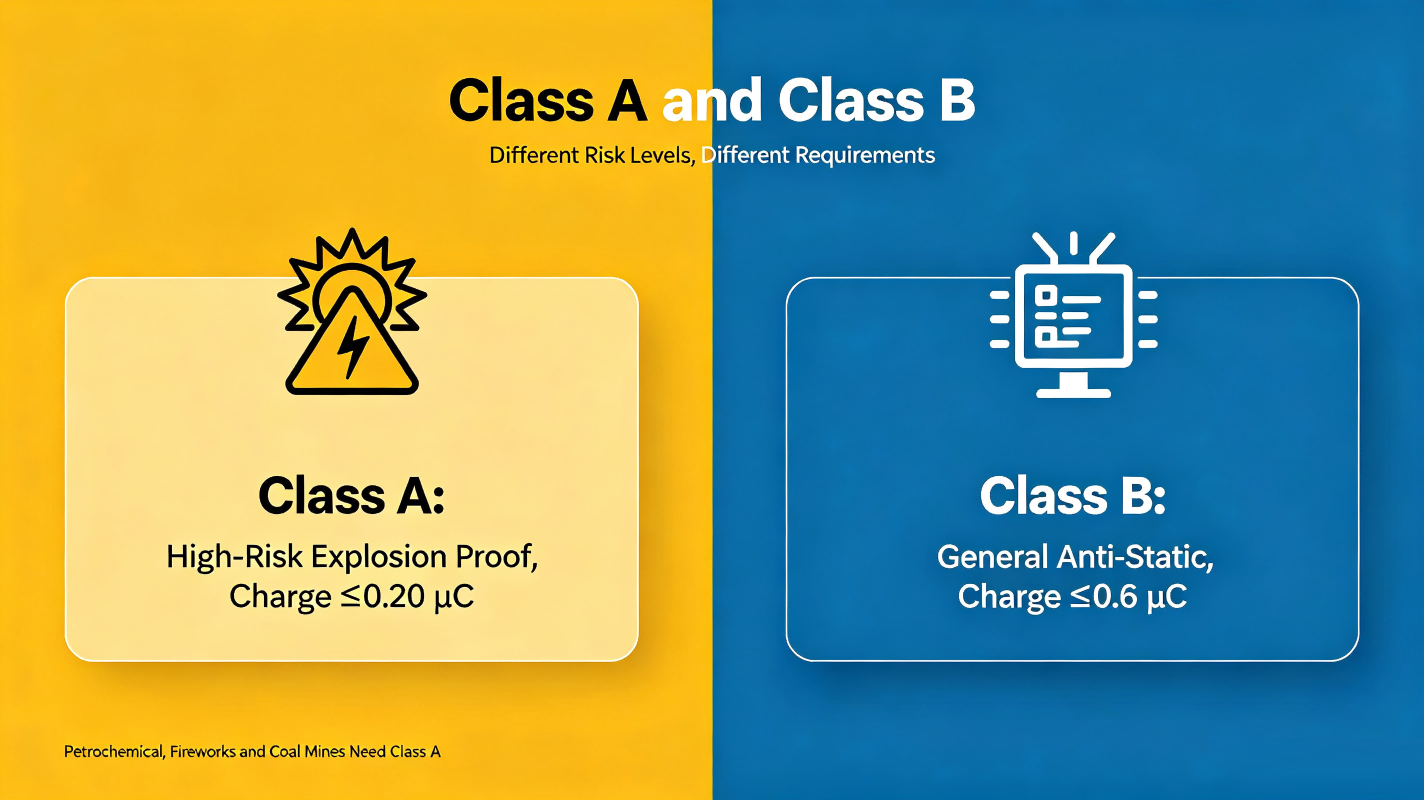
For high-risk explosion-proof scenarios, the requirement is even stricter—Class A anti-static clothing requires a charge quantity of ≤0.20 μC.
Indicator 3: Charge decay time – how fast static dissipates
Charge decay time is the time required for a charged fabric to decay from 1000 V to 100 V. GB 12014 requires ≤10 seconds. This indicator reflects how quickly the fabric "drains" static. The shorter the time, the faster the static dissipates.
Indicator 4: Wash durability – how many washes before anti-static performance fails
This is the indicator most buyers overlook, yet it's the most critical. Anti-static clothing isn't worn once and done—it gets washed repeatedly. If the conductive fibres break during washing, the anti-static function drops to zero.
According to GB/T 23316‑2021, anti‑static clothing must retain ≥80% performance after 50 washes. In other words, after 50 washes, surface resistance and charge quantity must still be within the standard range. Inferior anti-static garments may have conductive threads break after three to five washes, after which they're no different from ordinary workwear.
Indicator 5: Conductive filament spacing – a quality signal you can see with your own eyes
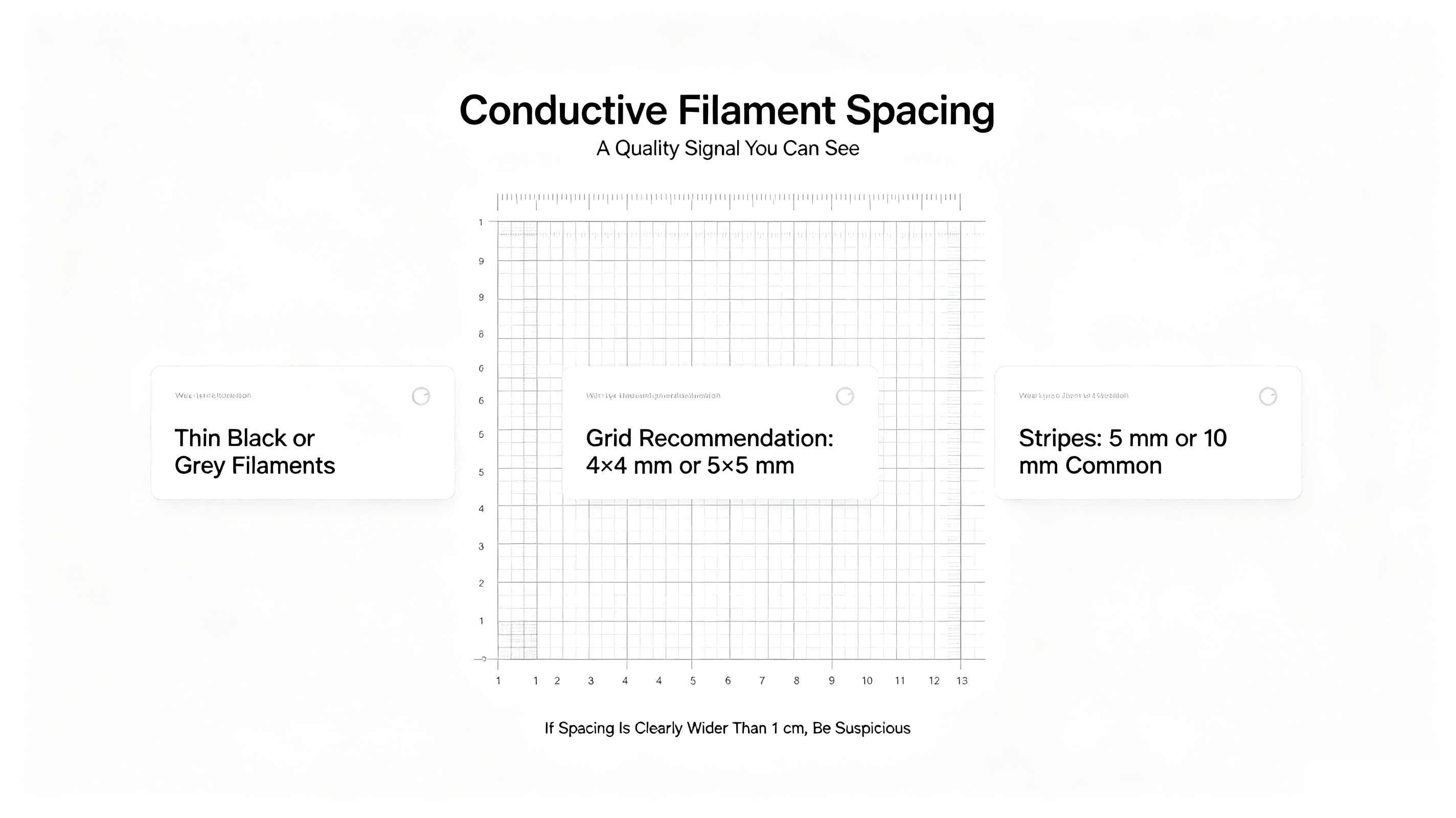
The conductive threads woven into anti-static fabric are usually thin black or grey filaments, distributed evenly in a grid or stripe pattern. The standard recommends a grid spacing of 4×4 mm or 5×5 mm; common industry specifications include 5 mm stripes and 10 mm stripes.
Conductive filament spacing is the easiest indicator to visually check on the spot. If the spacing is clearly wider than 1 cm, or there are only a few sparse threads, you can basically conclude the anti-static performance is substandard.
3. Classification of anti-static clothing: what's the difference between Class A and Class B?
GB 12014-2019 divides anti-static clothing into Class A and Class B.
Class A: for high-risk explosion-proof scenarios—refinery units in petrochemical plants, tanker unloading areas at petrol stations, LPG filling stations, fireworks and firecracker workshops, underground coal mines, flour mills, and aluminium powder processing workshops. These locations contain flammable gases, combustible liquids, or explosive dusts, and a single static spark can trigger an explosion. Class A anti-static clothing requires a charge quantity of ≤0.20 μC, stricter than Class B.
Class B: for general anti-static scenarios—electronic component assembly workshops, precision instrument laboratories, pharmaceutical cleanrooms. These locations have sensitive requirements for static, but no immediate explosion risk.
When purchasing, always ask the supplier – are you providing Class A or Class B? Does it comply with GB 12014‑2019? If they can't answer, or just say "all our products are anti‑static," that's a red flag.
4. Which industries must use anti‑static clothing?
The applications for anti‑static clothing are broader than many people imagine. Four categories are essential:
Category 1: High‑risk explosion‑proof scenarios
Petrochemicals – refineries, petrol stations, LPG filling stations. High concentrations of oil‑gas mixtures mean static discharge can cause an explosion. These roles often also require anti‑static clothing combined with flame retardancy.
Fireworks, gunpowder processing, ammunition production workshops – a static spark directly detonates explosives. Class A anti‑static clothing is mandatory.
Coal mines and dust environments—underground coal mining, flour mills, aluminium powder processing. Static can ignite coal dust or metal dust. Anti-static shoes are required as well, forming a complete static protection system.
Category 2: Electronics and semiconductor scenarios
Chips and semiconductors – wafer fabrication, chip packaging and testing workshops. Just 200 V of static can punch through a chip's gate oxide layer, causing over 30% of component failures. These workshops typically require low-particle-shedding Class A anti-static clothing, keeping human body potential below 100 V.
Precision electronics assembly – mobile phones, circuit boards, LCD screen production lines. Class B anti-static clothing is usually used, together with anti-static wrist straps and shoes, complying with IEC 61340-5-1.
Category 3: Pharmaceutical and cleanroom production scenarios
Pharmaceutical workshops – API synthesis, sterile preparation workshops. Anti-static clothing prevents static from attracting dust and drug powders, complying with GMP requirements. Class A cleanrooms require one-piece anti-static coveralls.
Food processing – dairy, baking, powdered food workshops. Prevents static from attracting hair and skin flakes, while also avoiding dust explosion risks.
Category 4: Precision instruments and laboratories
Operating theatres, electron microscope rooms, precision laboratories. Static interferes with equipment accuracy; workwear must be dust-free and static-free.

5. Practical guide to buying anti-static clothing: five inspection actions
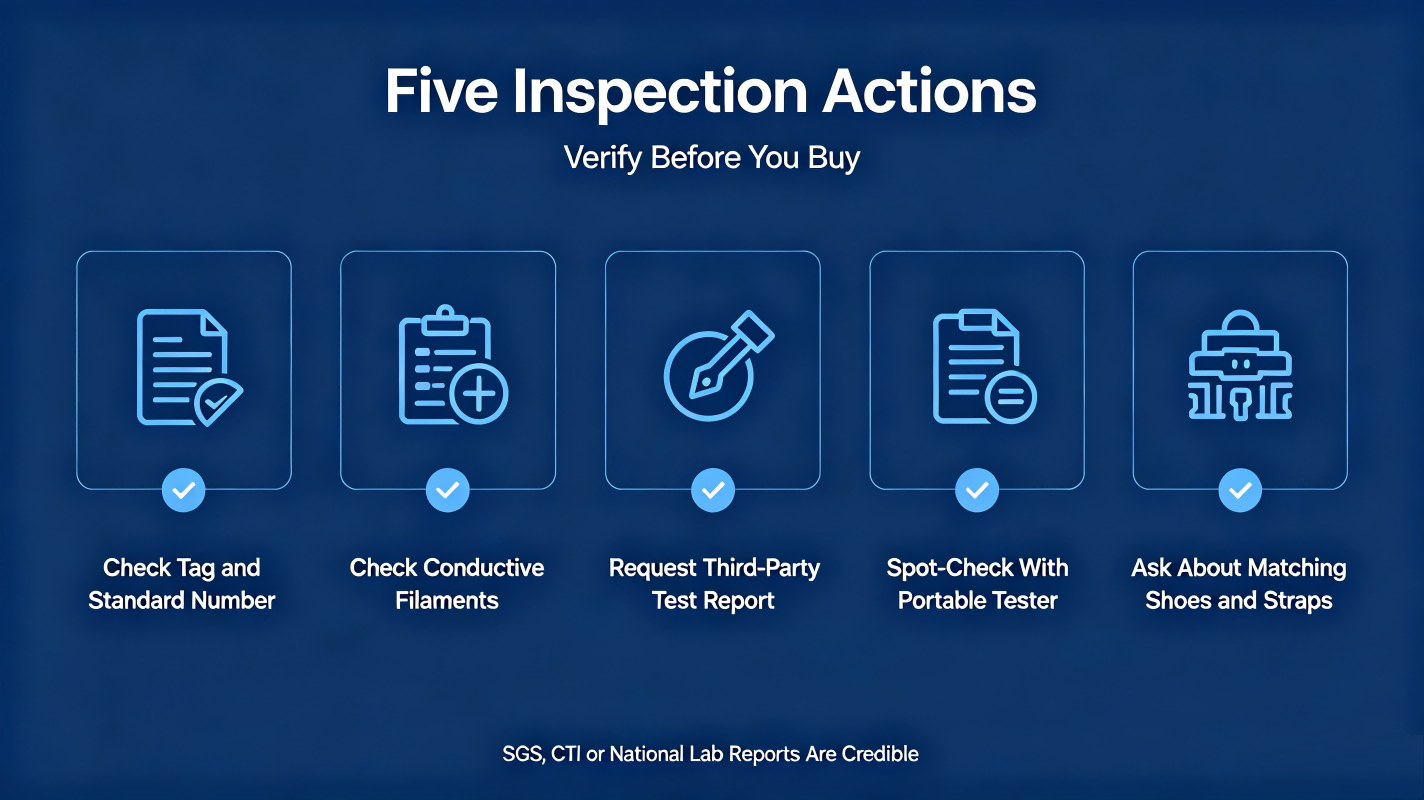
Now that you know the standard, here's the practical part. When purchasing anti-static clothing, carry out these five inspection actions:
Action 1: Check the tag and markings
Compliant anti-static clothing should have clear markings, including the anti-static symbol, standard number (GB 12014-2019), production date, and washing instructions. If the tag lacks a standard number or shows a different standard, be suspicious.
Action 2: Look at the conductive filaments
Open the fabric and observe the distribution of conductive filaments. They are usually thin black or grey threads, evenly distributed lengthwise or in a grid. Use a ruler to check the spacing—the standard recommends 4×4 mm or 5×5 mm grids; 5 mm stripes are common in the industry. If the spacing is too large, anti-static performance suffers.
Action 3: Request a third-party test report
Ask the supplier for a test report from a nationally accredited third-party testing institution, such as SGS, CTI, or the National Labour Protection Products Quality Supervision and Inspection Centre. When reviewing the report, pay attention to three details: Is the testing standard based on the latest GB 12014‑2019? Was performance tested after washing (not just initial state)? Does the fabric model in the report match the actual supply?
Action 4: Spot-check with a portable instrument
If the order quantity is large, equip yourself with a handheld surface resistance tester and randomly test different areas – chest, elbows, knees – to see if the values are within the acceptable range and stable. Surface resistance testing should be done under specific temperature and humidity conditions (23±2°C, 45%±5% RH); on‑site conditions may not meet this, but you can still do a preliminary screening.
Action 5: Ask about the complete system requirements
Anti‑static clothing isn't "wear it and you're protected" – it needs to form a complete static discharge path. Cuffs, trouser legs, and shoe soles should form a continuous conductive path, working with anti‑static shoes and anti‑static flooring to create a complete discharge system. If you wear anti‑static clothing but not anti‑static shoes, static will still build up on the body. Always ask – do we need matching anti‑static shoes and wrist straps?
6. Common misconceptions: the pitfalls buyers fall into most easily
Misconception 1: "More conductive filaments is better."
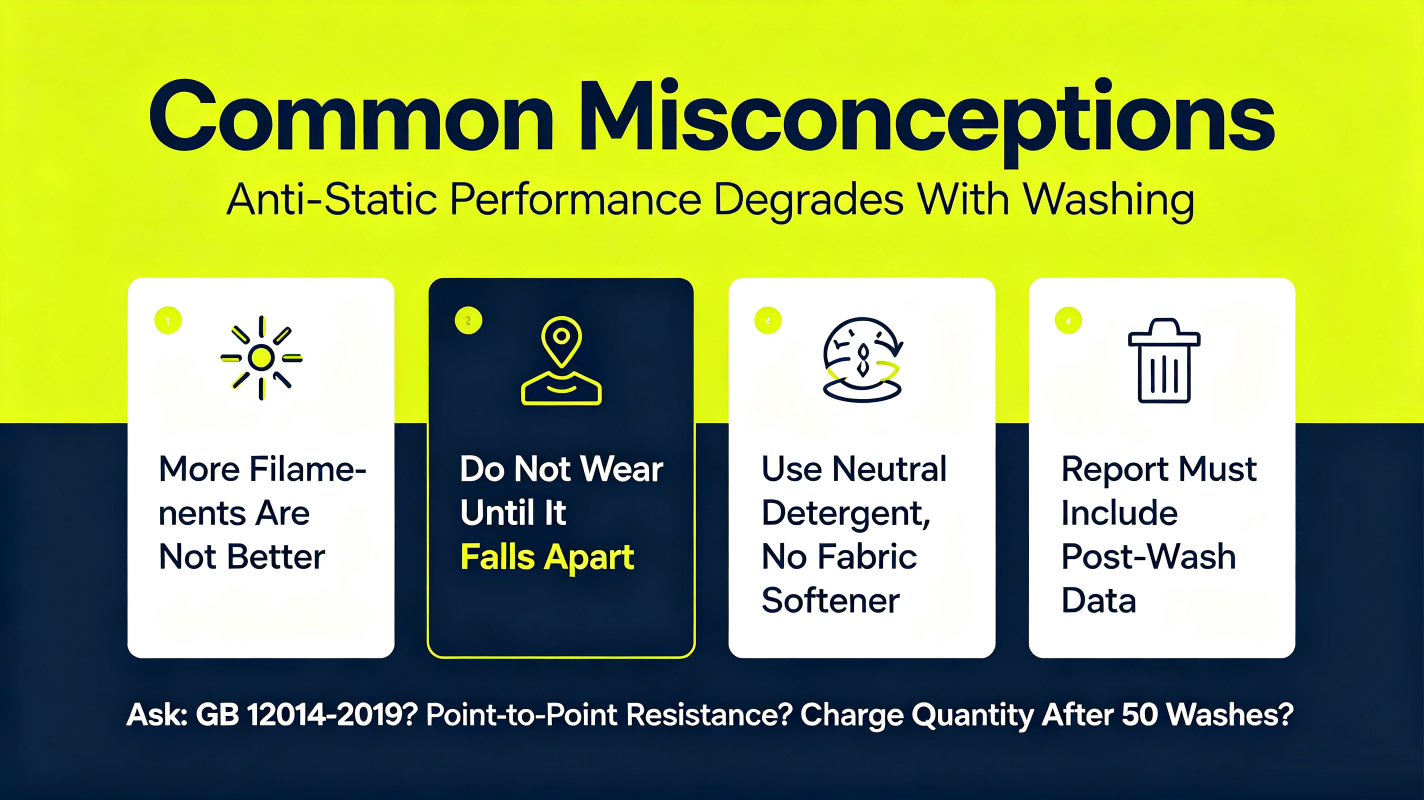
Too dense and it affects breathability and comfort; too sparse and static can't dissipate quickly. The standard-recommended 4×4 mm or 5×5 mm grid is a proven balance. It's not about density—it's about even distribution.
Misconception 2: "Anti-static clothing can be worn until it falls apart."
Anti-static performance degrades with washing and wear. If resistance exceeds the limit after 50 washes, replace the garment. It's recommended to retest charge quantity every 6 to 12 months; for electronics cleanroom garments, every 3 months.
Misconception 3: "Wash anti-static clothing with ordinary workwear."
Anti-static clothing should be washed with neutral detergent, water temperature not exceeding 40℃, and fabric softener must be avoided—softener coats the conductive fibres and forms an insulating layer, directly destroying anti-static performance.
Misconception 4: "A test report means everything is fine."
Check what state the report tested – initial or after washing? Many suppliers only provide reports for initial performance, without post-wash retesting. In real use, the garment is washed repeatedly.
A final honest word
GB 12014 is a national standard for anti-static clothing, filled with resistance ranges, charge limits, and washing requirements. For buyers, you don't need to memorise every number, but you do need to remember three things:
First, anti-static clothing is specialised labour protection equipment, not ordinary workwear. Its core indicators are surface resistance (1×10⁶ to 1×10¹¹ Ω), charge quantity (≤0.6 μC), and performance retention after washing (≥80% after 50 washes).
Second, check the standard number, check the test report, check the conductive filaments. Do these three checks, and you'll filter out most inferior products.
Third, anti-static clothing isn't just "a garment." It needs matching anti-static shoes and wrist straps to form a complete static discharge system. Wearing the clothing without the shoes is as good as not wearing it at all.
Next time a supplier says, "This is anti-static," ask them directly: "Does it comply with GB 12014-2019? What's the point-to-point resistance? What's the charge quantity after 50 washes? Can I see the report?" – being able to ask those questions already makes you more professional than most buyers.