O que você está procurando?


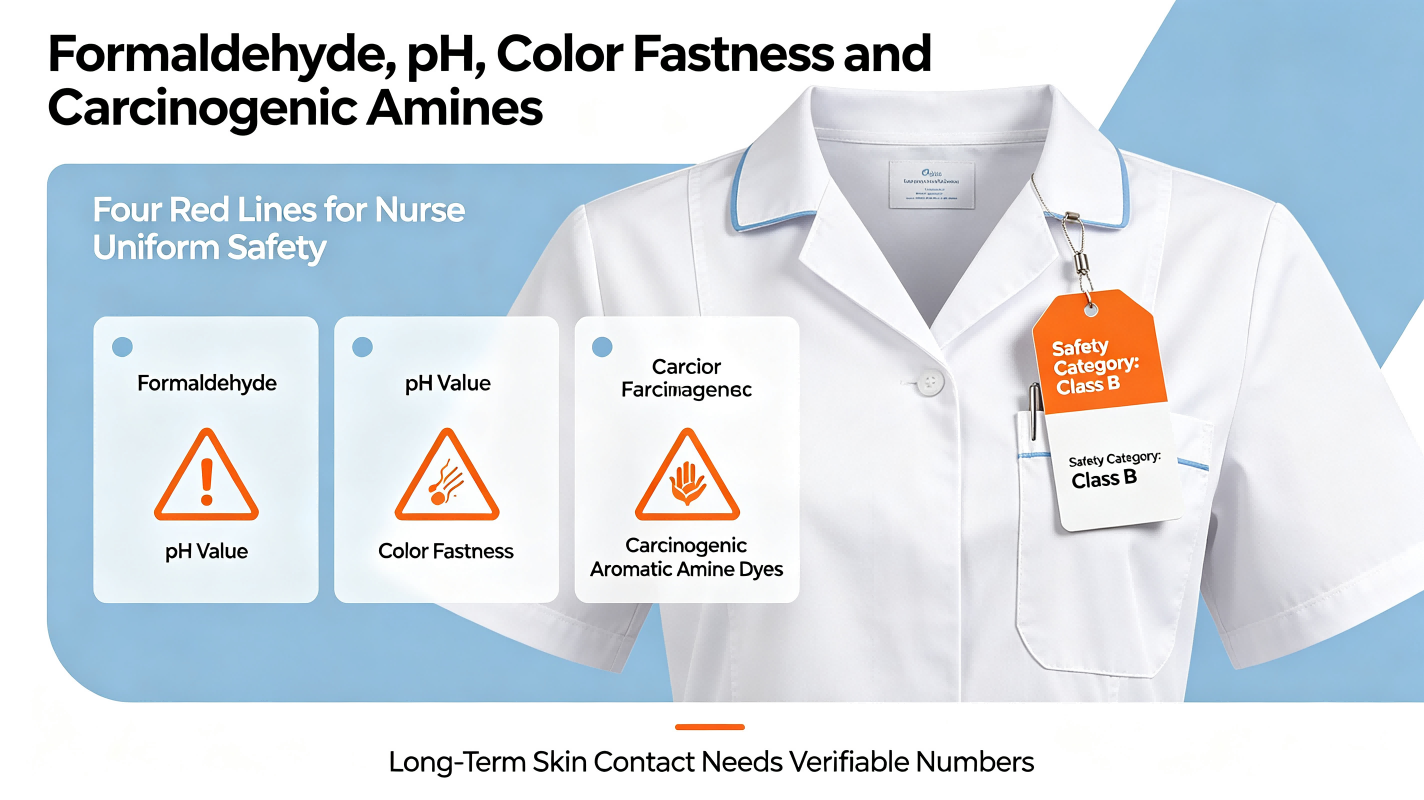
When buying nurse uniforms, what's the first thing you look at on the hang tag? Many people look at the fabric composition: how much cotton, how much polyester. But there's another line on the tag that deserves to be read first—"Safety category: Class B."
Behind that line are the four red lines of nurse uniform safety: formaldehyde content, pH value, decomposable carcinogenic aromatic amine dyes, and color fastness. Nurse uniforms are worn against the skin 8 to 12 hours a day, through sweating, friction, and repeated washing. If any one of these four indicators exceeds the limit, the impact isn't just "comfort" – it's skin health, and even long-term bodily risk.
Today, we're going to break these four indicators down in detail—what each one governs, what happens when it exceeds the limit, and how to verify them with numbers during procurement.
First, let's get clear: why is Class B the safety baseline for nurse uniforms?
The safety indicators for nurse uniforms are based on GB 18401-2010 "National General Safety Technical Code for Textile Products," a mandatory national standard. The standard divides textiles into three categories by end use: Class A for infants and toddlers, Class B for direct skin contact, and Class C for non-direct skin contact.
Nurse uniforms fall under Class B, because most of their area is in direct contact with the skin, they're worn for long periods, and they withstand repeated friction and sweat soaking. A common wording in hospital procurement announcements is: "Mandatory safety standard complies with GB 18401-2010 Class B; formaldehyde ≤75 mg/kg, pH 4.0–8.5, no odor, prohibited decomposable carcinogenic aromatic amine dyes." That is the line nurses must cross.
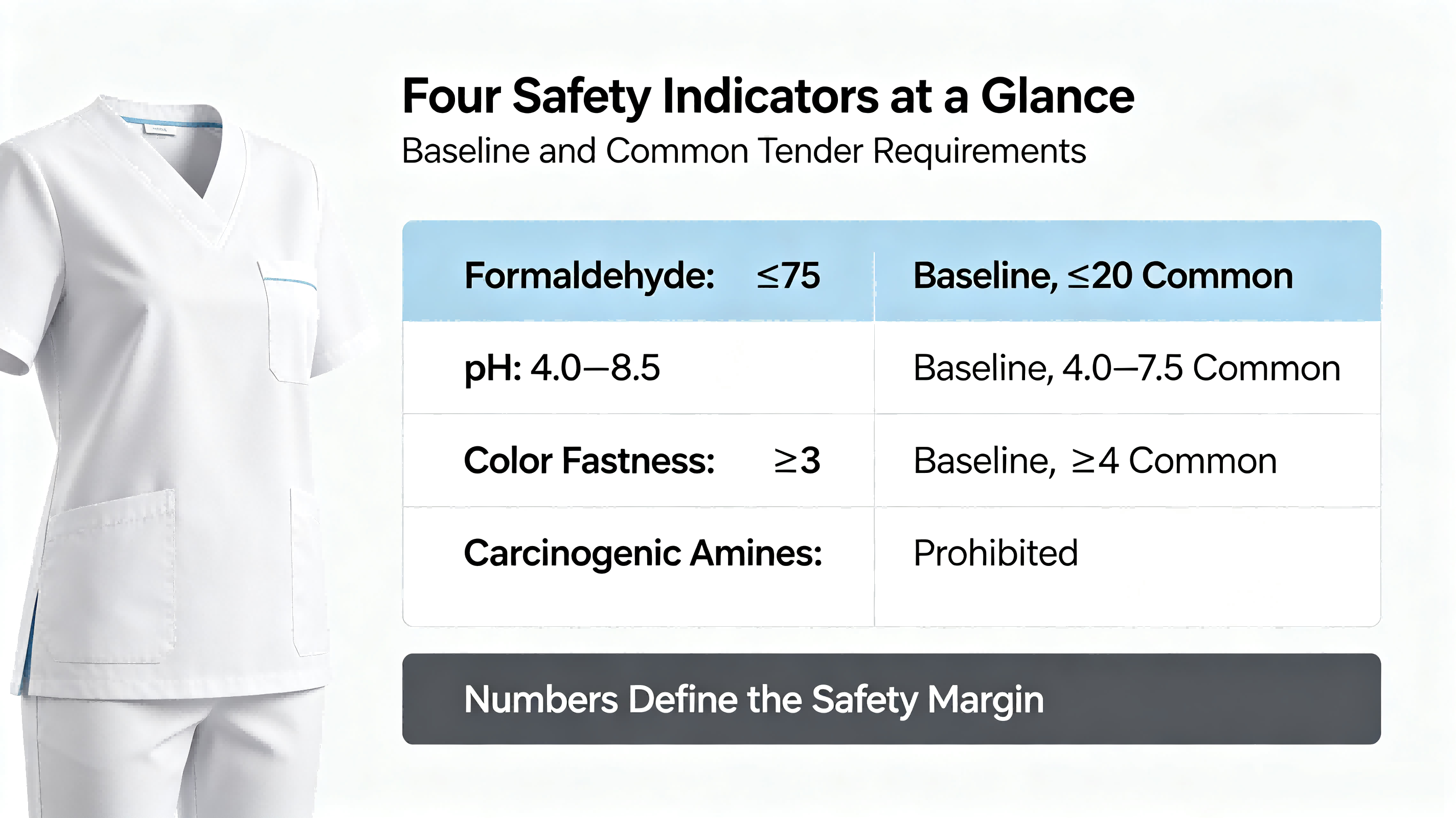
What level do Class B limits represent? Formaldehyde ≤75 mg/kg, pH 4.0–8.5, color fastness to water, perspiration, and dry rubbing ≥ grade 3, decomposable carcinogenic aromatic amine dyes prohibited. The Class C formaldehyde limit is 300 mg/kg—four times that of Class B. If a nurse's uniform worn against the skin every day is made to Class C, that's equivalent to applying the safety standard of an outer coat to a "second skin"—logically untenable.
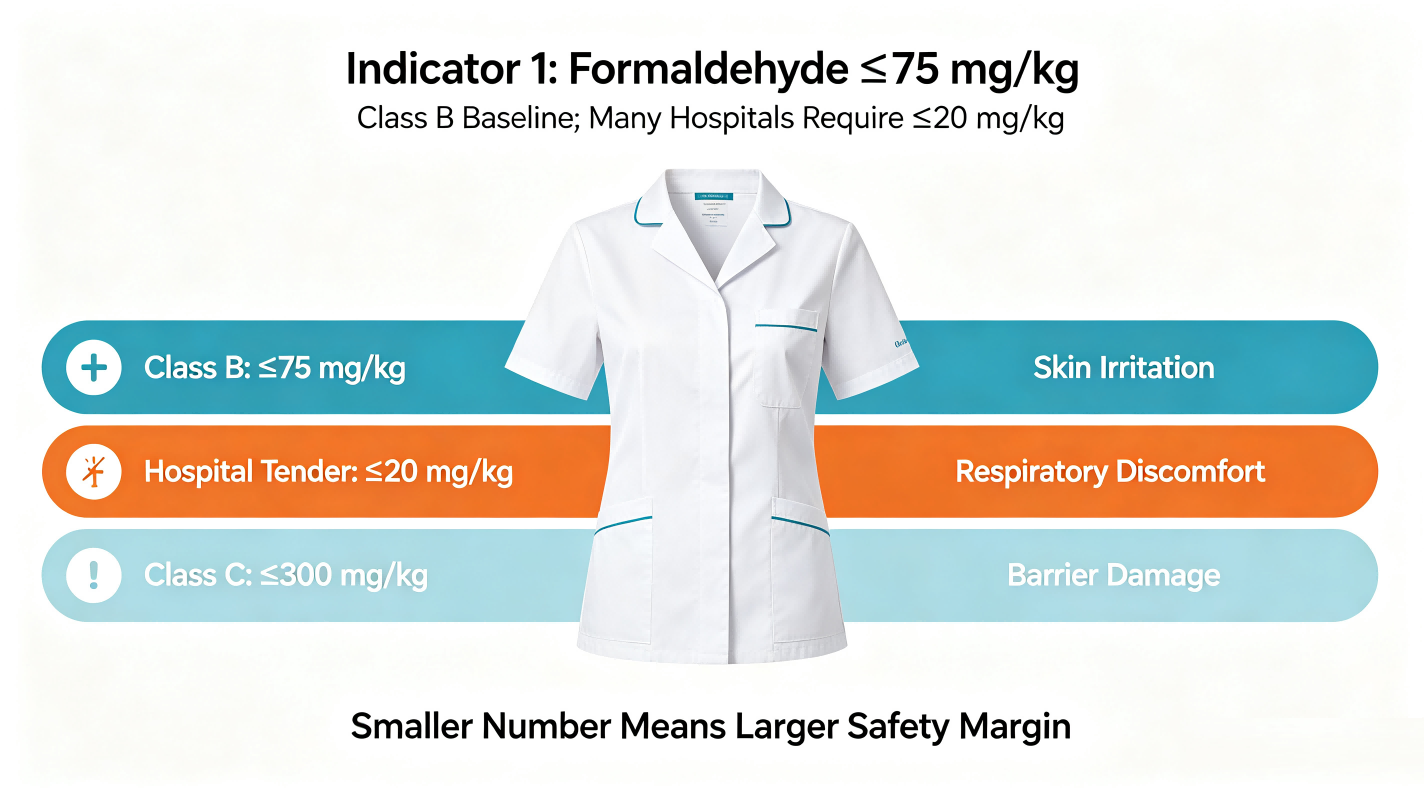
1. Formaldehyde: ≤75 mg/kg – what happens if it's exceeded?
Formaldehyde may remain in textiles as an auxiliary agent from dyeing and finishing. The permitted upper limit for Class B is 75 mg/kg.
What are the consequences of exceeding it? The most direct are skin and respiratory irritation. Formaldehyde damages the skin barrier, causing redness, itching, and rashes. Nurses sweat heavily and their pores are open during work, making it easier for free formaldehyde on the fabric to contact the skin through sweat. Long-term low-concentration exposure may also cause respiratory discomfort.
But in real-world procurement, many hospitals set stricter formaldehyde requirements for nurse uniforms than Class B. In a nurse uniform procurement in Sichuan, the tender parameters for summer nurse uniforms directly stated "formaldehyde content ≤20 mg/kg" and pH "4.0–7.5." Another bleached nurse uniform project also required "formaldehyde content ≤20 mg/kg; pH: 4.0–7.5." What does 20 mg/kg mean? That's the formaldehyde limit for Class A infant and toddler products in GB 18401. Hospitals are applying near-infant standards to nurse uniforms, showing that tolerance for formaldehyde in next-to-skin scenarios is extremely low.
How to check during procurement: Don't just ask "Is it Class B?" Ask directly: "What's the actual measured formaldehyde value? Does the report say ≤75 or ≤20?" The smaller the number, the greater the safety margin.
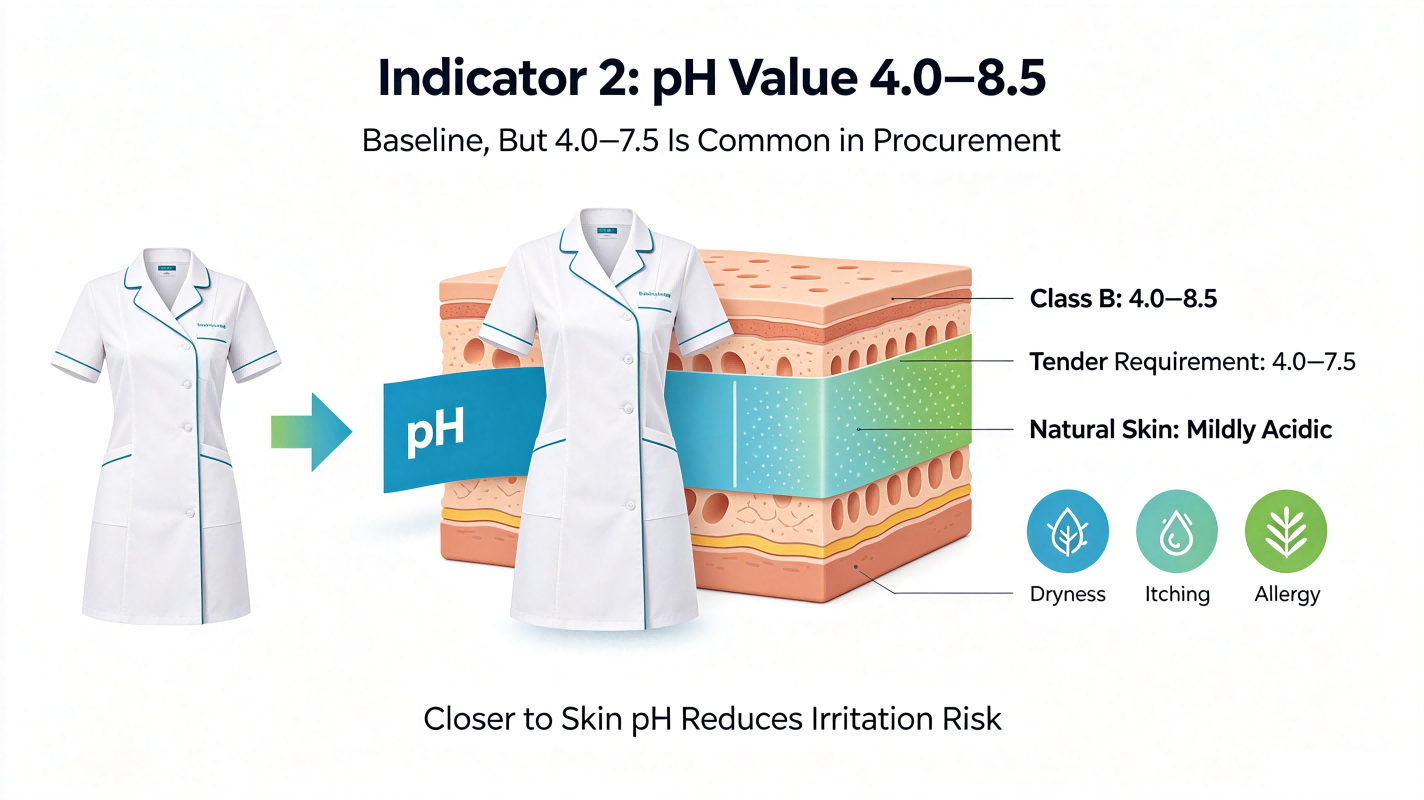
2. pH value: 4.0–8.5 is the baseline, but many hospitals set 7.5
Human skin surface is mildly acidic – a natural barrier. If fabric pH is too alkaline or too acidic, it destroys this barrier, causing dryness, itching, and even allergies. Class B frames pH between 4.0 and 8.5.
But in nurse uniform procurement, the more common stricter requirement is pH 4.0–7.5. The Sichuan nurse uniform project mentioned earlier required "pH: 4.0–7.5," and bleached nurse uniforms likewise required 4.0–7.5. A 7.5 upper limit is closer to the skin's natural mildly acidic environment than Class B's 8.5, with lower irritation risk.
You can't smell a pH problem – it requires testing. But one signal to watch for: if nurses report "prickling" or "itching" after putting on new workwear, or develop unexplained rashes, while ruling out formaldehyde, also suspect whether the pH is too alkaline.
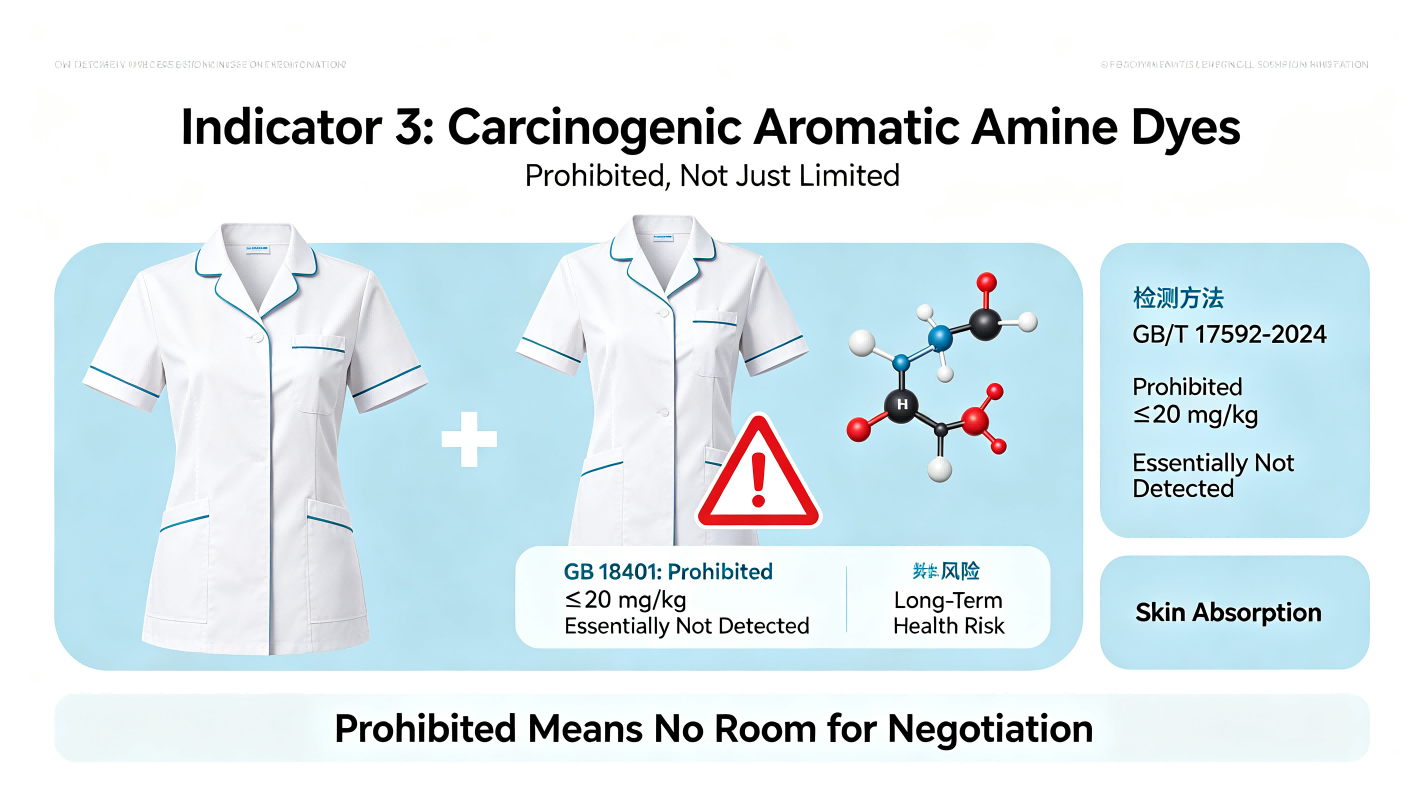
3. Decomposable carcinogenic aromatic amine dyes: not a "limit exceedance" issue, but a "prohibited" one
This item follows different logic from the previous three. Formaldehyde and pH are "limit value" issues; decomposable carcinogenic aromatic amine dyes are a "prohibited" issue. GB 18401 requires them to be prohibited, with a limit value of ≤20 mg/kg – essentially equivalent to "not detected."
Why so strict? These dyes decompose under certain conditions to release carcinogenic aromatic amines. After being absorbed through skin contact, long-term accumulation poses health risks. Nurse uniforms are worn against the skin every day – there's no room for negotiation on this point.
The testing method is based on GB/T 17592-2024 "Textiles – Determination of banned azo colorants", implemented on April 1, 2025. The detection threshold for mixed-color samples was tightened from 30 mg/kg to 20 mg/kg. During procurement, the report should say "not detected" or "≤20 mg/kg," not a vague "complies."
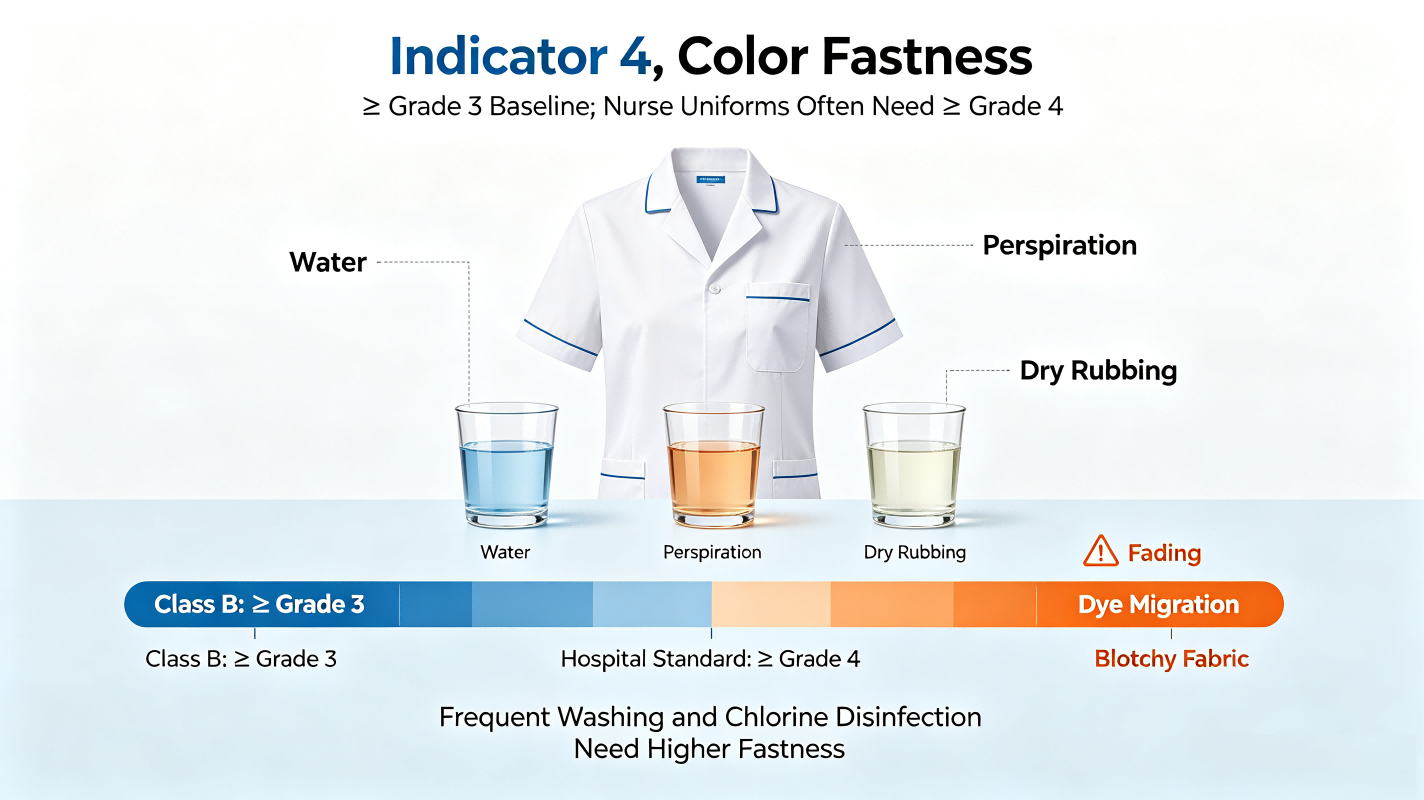
4. Color fastness: ≥ grade 3 is the baseline, but actual nurse uniform requirements are often ≥ grade 4
Color fastness governs how firmly the dye "holds on." Nurses sweat heavily; if dye on the fabric comes off after soaking in perspiration, dye molecules and heavy metal ions may be absorbed through the skin, causing itching, erythema, and contact dermatitis. At the same time, nurse uniforms with poor color fastness fade and go blotchy after a few washes – especially noticeable in colored versions.
GB 18401 Class B requires ≥ grade 3 for color fastness to water, acid perspiration, alkaline perspiration, and dry rubbing. But actual nurse uniform procurement standards are generally higher: a nurse uniform project in Henan required "color fastness to water, acid and alkaline perspiration, and dry rubbing ≥ grade 4"; a hospital in Hebei required color fastness (to soaping, perspiration, rubbing, and chlorine bleaching) ≥ grade 4; Sichuan summer nurse uniforms likewise required color fastness to water, acid perspiration, alkaline perspiration, and dry rubbing ≥ grade 4.
Grade 3 is a pass; grade 4 is the level nurse uniforms should have. Because nurse uniforms are washed far more frequently than ordinary clothing – two or three times a week, plus chlorine disinfection – fabric with insufficient color fastness won't survive many cycles.
5. How to use these four indicators to inspect goods during procurement?
Knowing the numbers, the next step is knowing how to use them.
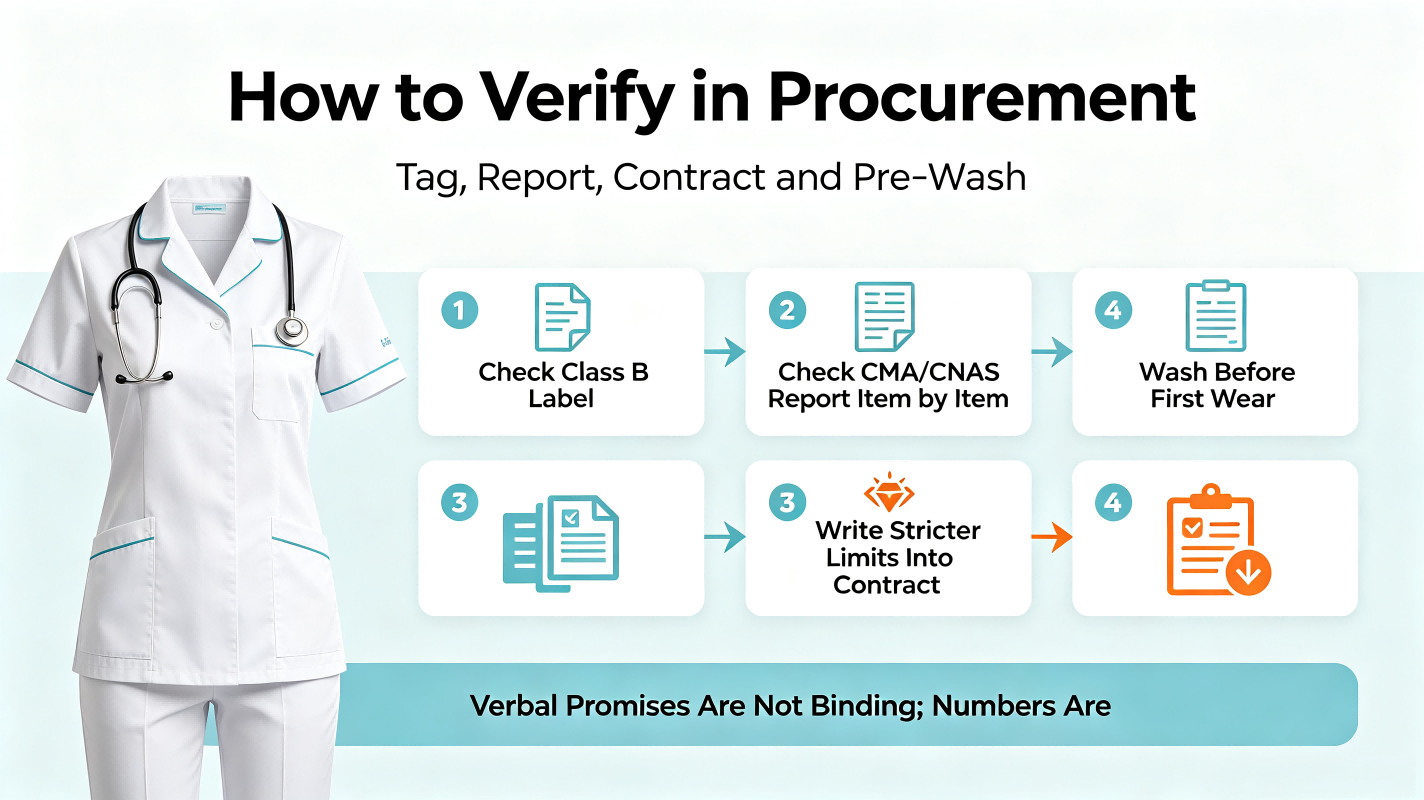
First, flip the hang tag and check the category first. If you can't find "Safety category: Class B," that's an immediate red flag. If they don't even dare to label the category, there's no need to discuss the rest.
Second, ask for a third-party test report and check each number. Require a test report issued by a CMA- or CNAS-accredited testing institution according to GB 18401-2010. Don't just look at the word "pass" – look at the specific values:
Third, write the stricter indicators into the contract. If the hospital requires formaldehyde ≤20, pH 4.0–7.5, and color fastness ≥ grade 4 for nurse uniforms, write exactly that in the contract—don't just write "complies with GB 18401 Class B." For bulk sampling, send samples to a third party for testing against the contract indicators; failures are treated as breach of contract.
Fourth, wash new nurse uniforms before wearing. Washing removes most free formaldehyde and loose dye, and helps neutralize pH. This is the simplest, lowest-cost protective measure.
A final honest word
Formaldehyde, pH value, color fastness, and carcinogenic aromatic amines in nurse uniforms – these four indicators are not a paper "compliance game." They correspond to real contact against a nurse's skin 8 to 12 hours a day.
Formaldehyde ≤75 mg/kg is the Class B baseline, but many hospitals are buying at ≤20 mg/kg; pH 4.0–8.5 is the baseline, but 4.0–7.5 is closer to skin; color fastness ≥ grade 3 is the baseline, but actual nurse uniform requirements are generally ≥ grade 4; for carcinogenic aromatic amine dyes, there is only one answer: not detected.
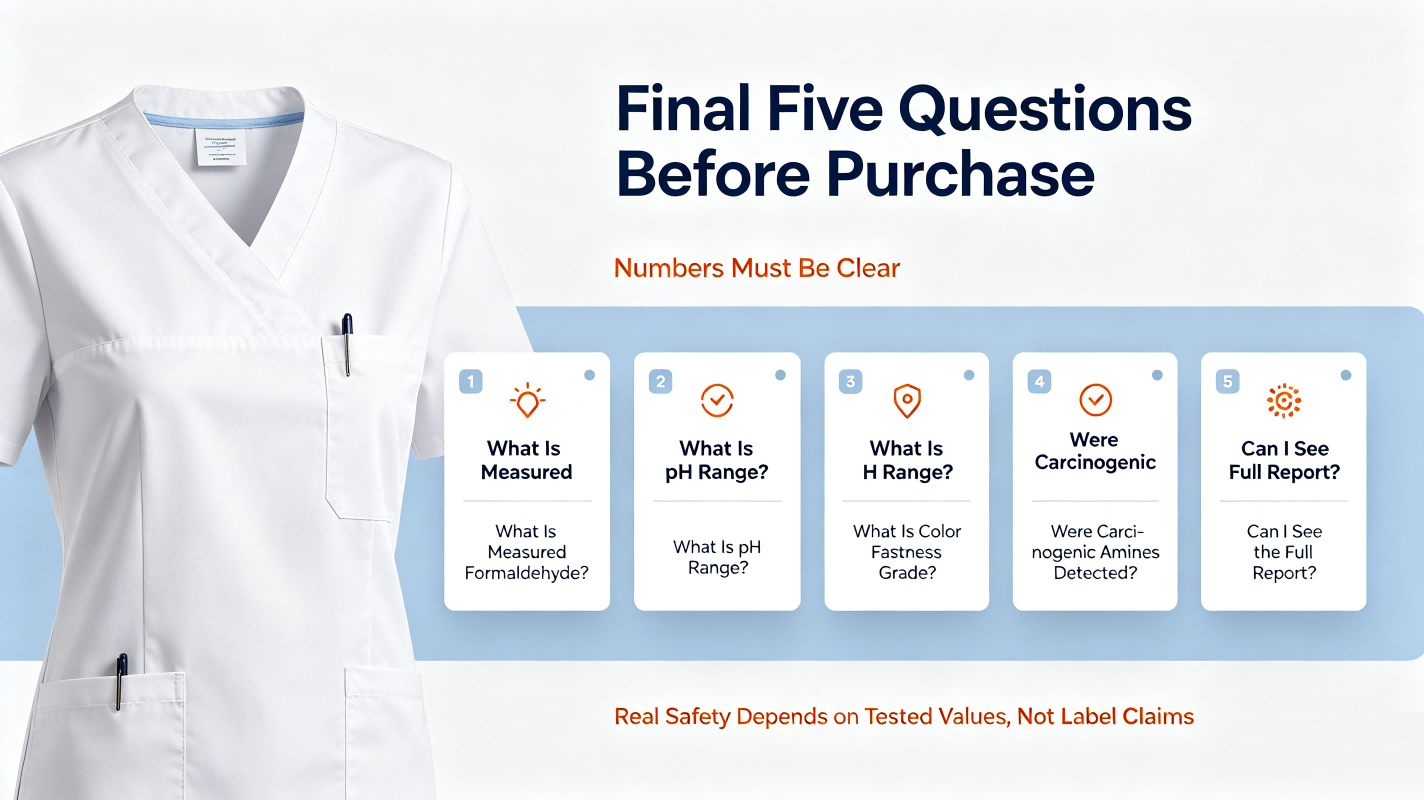
When buying, don't just ask "How much per piece?" Ask first: "What's the measured formaldehyde? What's the pH range? What grade is the color fastness? Were carcinogenic aromatic amine dyes detected? Can I see the report item by item?" – A supplier who can present these numbers is truly treating nurse uniforms as "next-to-skin battle gear," not selling them as ordinary workwear.